
Submission by tp bennett.
Being a good ancestor
Practice
1. Does the practice have a clearly stated purpose aligned with the planetary emergency? We are looking for a bold ambition here, and a practice culture which recognises the need for long-term thinking. For example, a strong mission, a theory of change, or a sustainability roadmap.
We design our projects to four key sustainable principles: Environment, Health & Wellness, Equity, Diversity& Inclusivity, and Social Value. Our 14 Principal Members at tp bennett have signed up to the following Strategic Imperative that: “tp bennett is the ‘go-to’ practice for sustainability in Architecture and Interiors. We have an unconscious sustainability process that is embedded within the practice, its projects and all key decision making”. The leadership support the work that our sustainability team do to embed all our key principles in our projects, and to upskill our architects and interior designers to do the same.
TP Bennett are in the process of signing up to the Science Based Target initiative (STBi) which aligns our own Scope 1, 2 & 3 for the Paris Agreement temperature limit of 1.5 Degrees Celsius. As a practice we are due to set near term reduction targets of 63% of our annual carbon emissions by 2035 and 90% by 2050, allowing 10 for Neutralisation post 2050 as well as separately using other mitigation methods throughout.
2. Does the practice have a clear succession plan, which passes on ownership and protects the values and legacy of those who built and contributed to the practice? For example is the practice an employee owned trust.
The practice was founded in 1921 by Sir Thomas Penberthy Bennett and converted to a Limited Liability Partnership (LLP) in October 2005. The company is now led by directors who are proud to build on over a century of experience and are passionately committed to designing environments that meet and exceed our clients’ expectations. As an LLP we have 13 Principal Members and over 60 LLP Members. These Principal Members and Members form part of the company succession plan. This is structured so that there is on continual succession plan.
TP Bennett is a Limited Liability Partnership (LLP) and therefore has a business structure that combines the benefits of a partnership with limited liability, meaning members are not personally liable for the LLP’s debts beyond their investment. TP Bennett LLP uses a system where employees Director Level and above can become a member and have an investment share within the company.
3. Does the practice share research and knowledge for the benefit of society and the wider world? For example, you regularly carry out post occupancy evaluation and share information with others.
We’ve invested in diverse research and knowledge-sharing initiatives to advance sustainability across the industry, and with young people of all ages. We regularly share our knowledge, research and lessons learned on panels, talks, podcasts and other events. These include Carbon Literacy Training to raise climate awareness with Better Bankside BID, and Ad Lib – our in-house materials library – currently being developed for wider industry use. We contributed to a policy paper on material reuse with Orms and Lancaster University with our expertise in BIM and material passports. We launched the ‘Regen Panel’ with Greengage – a shared series of panel talks where junior team members present 6-minute talks on sustainability topics, supporting both learning and public speaking skills. We also collaborated with industry experts to research the upfront carbon of Cat B office fit outs, contributing to the UK Net Zero Carbon Buildings Standard. We carry out research projects in association with universities, and other key organisations to share knowledge widely.
Project
1. Does the practice advocate for long-term thinking at the outset of projects? Do you initiate projects with long-term thinking and challenge the client on design life? Also, can the practice demonstrate that this approach has worked – with a shorter or longer design life, or an innovative approach to financing or payback period?
We engage clients early in each project to shape the sustainability brief and continue these conversations throughout design. We encourage long-term thinking, weighing upfront costs against lifetime benefits like energy savings, environmental impact, and occupant wellbeing. We advocate for assessing both whole life cycle cost and carbon to support informed decisions.
For example, at Cornerstone in Woking – a Build-to-Rent office-to-residential conversion–the client invested in high-quality plywood built-in joinery for a high-quality finish that promotes efficient use of space and furniture. Despite a higher initial cost, it delivered durable storage and a natural timber finish, enhancing occupant experience and long-term value. Another example would be 11 & 12 Wellington place where the building was designed to be fully electric and net zero carbon in operation, designed to high sustainability standards. It is also the first NABERS design reviewed Five Star building in the UK outside of London, which implies the use of performance-based, long-term environmental thinking. Creating a forward-looking, lifecycle-conscious design approach.
2. Do your projects take account of the future climate and the need for resilience? For example, do the projects demonstrate flexibility, design for adaptation, design for disassembly, non-deterministic solutions, or demountable structures.
We explore alternative future uses for buildings to ensure adaptability and long-term value, considering site and area constraints. We’re trialling material passports on live projects and developing an occupant-facing app to promote sustainable practices throughout a building’s lifecycle. Early-stage analysis using Revit plug-ins and standalone software helps assess solar orientation, glazing ratios, and mixed-mode ventilation for climate resilience. Our dedicated ‘Compute’ team works closely with the sustainability team to create tools such as ‘Viride’ for early-stage analysis and option studies that embed sustainability into the core design process. The Langfield is a clear example of this approach in practice. The building features flexible, sub-dividable floorplates, enabling future adaptability, and retains much of the existing structure and foundations to reduce embodied carbon. Its optimised façade balances heat loss, solar gain, and comfort. The project significantly outperforms GLA embodied carbon targets, demonstrating strong long-term climate resilience and whole-life carbon performance.
3. Do the majority of your projects go beyond mitigating negatives and towards optimising positives? For example, are they meeting or exceeding the RIBA 2030 Challenge.
We follow an internal sustainability process that includes a project-wide sustainability plan and checklist, addressing four key focus areas: Environment, Health & Wellness, Equity, Diversity & Inclusivity, and Social Value. This helps us review and improve each project, aiming to maximise positive impacts and minimise negative ones. We are continuously refining our objectives and targets to drive better outcomes. While we don’t yet have centralised data to track the exact percentage of projects meeting specific standards, we’re actively working to establish this. It will support knowledge sharing both within our practice and across the wider industry
We are actively trialling materials passports on selected projects and exploring how this can be combined with an app for the occupants use to convey the sustainability message throughout the building’s occupancy and ongoing maintenance.
Co-evolving with nature
Practice
1. Does the practice use biophilia within the office or regularly host meetings and retreats in natural settings? For example do you have extensive planting within the office or rely on natural patterns and imagery for stress relief or quiet areas.
We have planting throughout the office, and in most meeting rooms. In the basement we have imagery of nature on the wall of the staff canteen and a moss wall to the lower ground lift lobby. We consider the 14 patterns of biophilia and utilise natural materials and textures in our offices.
Staff have engaged in mental health walks in the local area, exploring parks and nature, as well as organised day-long events such as the JLL triathlon, and volunteered team members time with the Outward Bound Trust alongside local schools for week-long excursions into nature. These trips support the work that the Outward Bound Trust do to empower young people through their experiences in nature, and is positive for both the young people, and our staff that join every year. We have a staff wellbeing space with calming colours and textures that can be used for a variety of uses, such as a nap, prayer or ‘reset’ space for time out by any staff member.
2. Can the practice share examples where it has considered nature in decision making? For example by having a nature proxy to encourage eco-centric decision making, using natural systems as inspiration for the company structure, recognising the seasonal nature of people’s capacity and workload or celebrating equinoxes and solstices together.
Yes, we consciously consider nature and seasonal rhythms in our decision-making, recognising how natural cycles impact wellbeing and productivity. During the winter months, we reduce CPDs and webinars, creating space for rest and reflection. In January, we shift focus toward enhanced wellbeing, supporting colleagues who may find the darker winter season more challenging for mental health. We also have a mandatory office closure over the Christmas break to encourage proper rest. In summer, we align with the season’s energy and social nature by offering greater flexibility around annual leave, scaling back internal events and CPDs so staff can spend more time with family and friends. This seasonal approach helps us foster a more balanced, nature-informed working culture.
3. Is the practice supporting nature locally and nationally? For example, does the practice support local gardens, gardeners, planting programmes, rewilding programmes or advocate for changes in legislation to protect nature.
We engage with the ‘Better Bankside’ Business Improvement District for workshops on planting, both in our locale and with our Wellbeing TPB+ group for internal events to create planting that staff can craft and then take home.
Through our connections with Wates Residential, members of our team have, and continue to, volunteer in Barking and Dagenham with the initiative ‘Keeping Barking clean’. These events occur throughout spring/summer and includes litter picking in the community and helping the ‘Friends of Phoenix Park’ to support the maintenance of their community garden.
Through our joint ‘Regen’ panel speaking initiative with the local sustainability consultancy Greengage we have hosted panels on a variety of topics including Biodiversity to share learnings and educate both practices about what we can achieve within our various disciplines through education and advocacy.
Project
1. Can the practice demonstrate projects which strive to match the performance of a mature ecosystem? As a minimum this would mean achieving biodiversity net gain.
We aim to maximise biodiversity in all our projects and have multiple projects which have achieved biodiversity net gain. A good example of this would be our planning scheme for a mixed use development at Cavalry Barracks in Hounslow where there was a landscape-led solution for a large green space at the heart of the site, bordered by biodiverse planting and play spaces with green corridors connecting this to neighbouring parks and towards heathlands.
2. Is the practice working on material stewardship? For example, evidence could be shown through repeated use of low carbon materials, extensive material libraries and research or publications supporting responsible use of materials and elimination of waste.
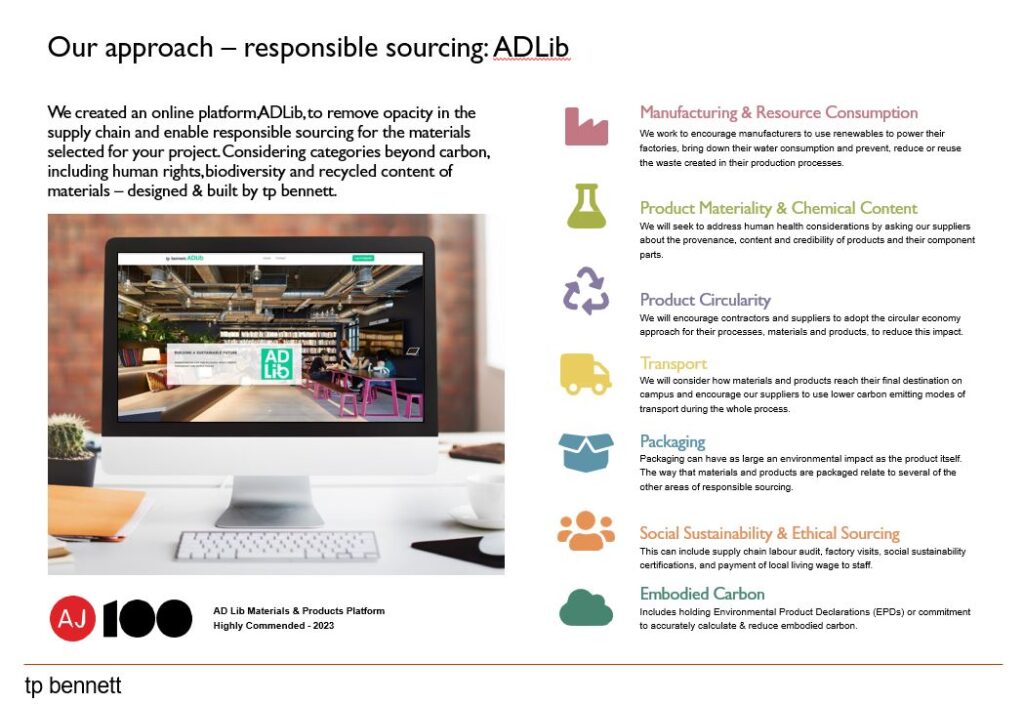
We are champions in the use of healthy and low carbon materials and have developed an extensive online database of sustainable materials for our staff to use when selecting products and materials for their projects called AD Lib. The AD Lib database includes product images, sustainability credentials and other aspects of performance uploaded and regularly updated by suppliers and rated according to our sustainability criteria. Our aim is to make this platform open source later this year so it can benefit others in the industry. We are bringing our physical materials library in line with the online platform to make it easier to access more sustainable options and harder to access less sustainable materials.
We are working on Material Passports on several projects and exploring how to align this with an app for occupants to better educate and share the sustainability information embedded in the building and fitout with the end users and FM teams.
3. Do the majority of projects demonstrate the use of biologically-inspired approaches such as Bioregionalism, Biophilia, Biomimicry, Ecomimicry (also referred to as Ecosystems Thinking, Industrial Ecology or Industrial Symbiosis) or BioTRIZ?
Use of Biophilia is a key consideration in many of our projects. We are increasingly using biophilic principles to underpin the design process within our interiors division, informing design decisions that enhance the occupant experience. “Project sites are also analysed according to the 14 Biophilic Principles and what they offer without any work, and then we aim to add to these and layer onto it through the design process. “These include Natural Analogues, Nature within the space and Nature of the space.
Creating a just space for people
Practice
1. Does the practice have a progressive EDI policy and can you evidence many forms of diversity, which are welcomed and acknowledged, within the practice?
We have a comprehensive EDI policy and we have six employee resource groups, known internally as TPB+. These community groups have been created to provide both a safe space and network for colleagues, as well as a platform to advocate for positive change inside both tp bennett and our wider industry. Our ‘Women in Design and Architecture’ group collaborated with our ‘People and Culture’ team has launched our new menopause policy, which includes 5 additional days of leave.
Our ‘Guardians’ TPB+ group have partnered with ‘Pregnant Than Screwed’ this year to roll out line manager training around care following an excellent talk from them at International Womens Day. As well as advocating for enhanced, shared parental leave which is due to be launched this year. Our wellbeing group underpins all our other groups and have done extensive work around Mental Health – including supporting our new Mental Health First Aiders. As a united force our groups collaborate regularly to ensure that the changes we make as a business are best for all.
2. Does the practice operate a no overtime culture, meet the living wage consistently, and stipulate a fair salary ratio between staff of all levels?
We are certified a Living Wage Employer by the Living Wage Foundation. We review salaries against our both our Gender pay gap and Race and Ethnicity pay gap reporting to consider fairness of salaries. We don’t have an overtime culture, and the building is locked each night at 7:30pm, unless people make special arrangements in advance for out-of-hours access.
We also support hybrid working to enable a better work-life balance with 3 days in the office for team collaboration, and the workplace location for the remaining weekdays are decided by the employee to suit their needs. This can assist with people who need either high or low stimulation environments for focussed work and facilitates better time management for each staff member.
3. Does the practice support charities, community groups, social enterprises, action groups and others through pro-bono work, charitable giving or in-kind donations?
We bring our total assets – cash, voice, network, physical assets, time, and skills – to the table in our support of a group of key charity partners (The Outward Bound Trust, Change Please, Impact Dance and Cook for Good), as well as creating impact through our social value offer on individual design projects. This includes hosting events in our office space, introducing our charity partners to other stakeholders, advocacy, staff volunteering, pro bono design, and traditional philanthropy.
One example is part of a pilot, where we have repurposed two London double-decker buses, transforming them into support assistance for the Change Please Foundation, a social enterprise, which supports people experiencing homelessness. The Driving for Change initiative is an all-in-one direct intervention service providing those experiencing homelessness access to free GP consultations, haircuts, dental care, digital and financial literacy training, employment support, shower facilities, therapy assessments, and essential everyday items.
4. Does the practice publicly refuse to work with certain clients, suppliers or organisations on ethical grounds?
We do not make a public statement on this matter. However, we have been updating our modern slavery statement. Driven by this, and a greater focus on ethical practices like Ecovadis, a list of ‘controversial’ industries has been circulated at board level, and the intention is to tighten up our processes by implementing a more comprehensive upstream due diligence process on potentially sensitive projects/ clients (currently we check only on financial indicators).
Project
1. Do the projects demonstrate deep engagement with local stakeholders and end users? For example, is there evidence that your project engagement goes beyond consultation towards co-design?
At the outset of every project, we aim to gain a deep understanding of a client’s aspirations for a project. This includes fully engaging with the client to understand the projects sustainability aspirations.
This level of engagement varies from client to client but includes sustainability workshops at the outset of a project to understand the key drivers and high-level sustainability aspirations (Re-Use Strategy, Materials Responsibly Sourced, Net Zero Carbon & ED&I). Aligning these with potential assessments (BREEAM / WELL / NABERS / LEED) – using these as a springboard for further advancements.
On a recent project for Open Society Foundations (OSF), we conducted workshops with OSF colleagues at Cambridge University to challenge our understanding of ED&I. Going well beyond standard engagement practices.
2. Do your projects create connected and resilient places which positively contribute to their neighbourhoods and allow equality of access? For example, do your projects create economic opportunity, retain value locally and generate social value?
We see a large part of our role as architects is to create connected and resilient places and a major element of this is ensuring the projects we work on create the best economic opportunity and generate social value. We’ve been leading the field in this endeavour, from creating award winning education environments across Europe to delivering multiple hospitals across Ghana and Cote Ivoire. On recent projects we’ve been using The Social Value Portal to measure, manage and report on social value throughout the project design stages.
We regularly volunteer hours during a project to work with local charities to provide pro-bono design services. Local charities we’ve worked with include:
- Cook for Good – we designed a community kitchen as part of our work with Meta in Kings Cross.
- Impact Dance – we provided pro-bono design services to deliver a new dance studio for this leading London social enterprise
- Carbon Literacy Training – We have partnered with Better Bankside to provide training on Carbon for our immediate area in Southwark to spread environmental knowledge.
3. Do the majority of your projects promote equity in society, and consider all people, not only the building inhabitants? For example, do your projects show due regard for workers within the supply chain and take active steps to avoid modern slavery?
When working on projects we always aim to promote equality, and consider all people, not only the building inhabitants. This includes having a zero tolerance for slavery and human trafficking and seek to partner with suppliers whose values and standards align with ours.