
Submission by Office S&M Architects.
Being a good ancestor
Practice
1. Does the practice have a clearly stated purpose aligned with the planetary emergency? We are looking for a bold ambition here, and a practice culture which recognises the need for long-term thinking. For example, a strong mission, a theory of change, or a sustainability roadmap.
One of our practice’ s five key values is that “We believe being green doesn’t need to be grey”. This approach builds on our mantra of “We believe in doing more with less” which addresses the need for joy and sustainability. More specifically we focus on “Use natural and recycled materials to deliver low embodied carbon and low operational carbon spaces.” We use this approach through the operation of the practice and the delivery of our projects, using each as a chance to go further and build on knowledge gained.
2. Does the practice have a clear succession plan, which passes on ownership and protects the values and legacy of those who built and contributed to the practice? For example is the practice an employee owned trust.
No.
3. Does the practice share research and knowledge for the benefit of society and the wider world? For example, you regularly carry out post occupancy evaluation and share information with others.
Yes, we share research widely through publications and tours. For example, with the Tate Institute, a net zero in operation retrofit using circular and natural materials, we have run tours to spread approaches of delivering circular economy principles in practical ways, while also delivering talks at the RCA and other institutions. Our work is regularly published, and we promote the retrofit-first approach of our projects, as well as sharing the specific materials and techniques we have used in the work. More broadly, we share advice and approaches to practice broadly with other architectural firms to lift the profession as a whole where possible.
Project
1. Does the practice advocate for long-term thinking at the outset of projects? Do you initiate projects with long-term thinking and challenge the client on design life? Also, can the practice demonstrate that this approach has worked – with a shorter or longer design life, or an innovative approach to financing or payback period?
Yes, we have a material-led approach to projects which at the outset considers embodied carbon, lifecycle and performance. We often challenge clients, both to think in new ways and to expose them to innovative solutions. With Park House, we used screw piles, timber structure, and timber finishes to create an extension which treads lightly, while the interior and exterior are designed as much for non-humans, in particular trees and cats, as for humans.
2. Do your projects take account of the future climate and the need for resilience? For example, do the projects demonstrate flexibility, design for adaptation, design for disassembly, non-deterministic solutions, or demountable structures.
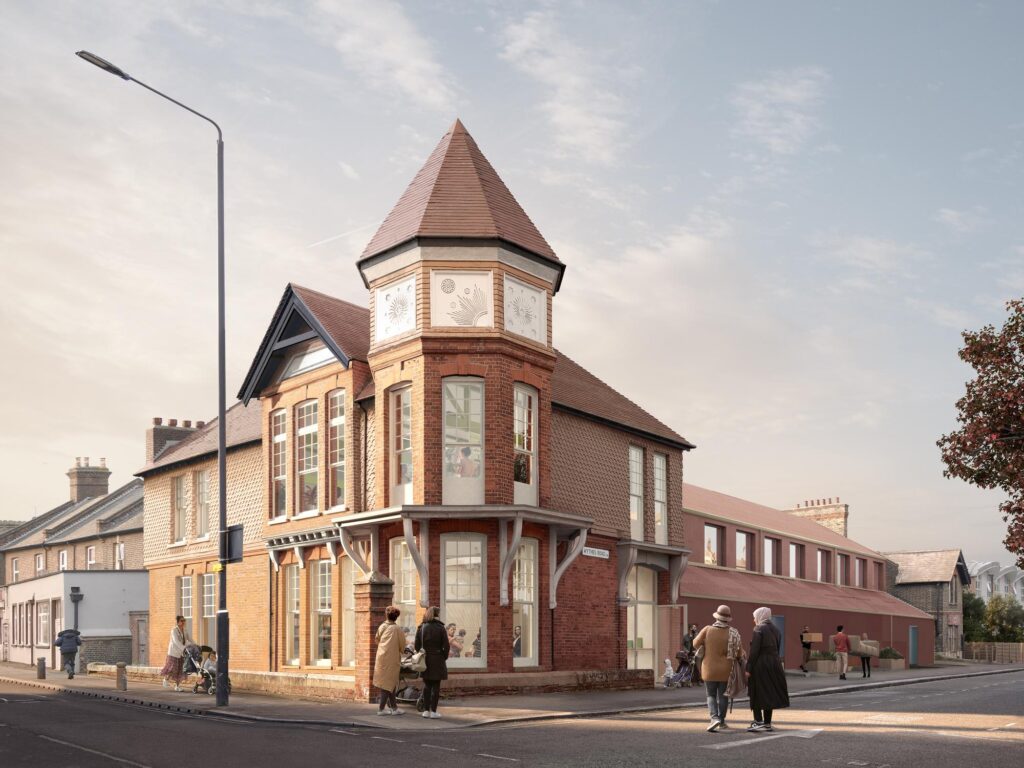
Yes, we design flexibility into our projects. This ranges from the adaptability of spaces and a loose fit approach, to circular approaches using lime mortar and screwed or bolted fixings. As an example of each, our Goldsmith Mews housing is designed to remove the risk of overheating, while providing a layout that can be used intergenerationally. Meanwhile, the Tate Institute has used timber mined from the building itself to repair parts of the roof, which are then fixed with bolted connections on lime mortar-bedded walls, in order to support future disassembly when the building needs repair in another 150 years.
3. Do the majority of your projects go beyond mitigating negatives and towards optimising positives? For example, are they meeting or exceeding the RIBA 2030 Challenge.
Yes, we are signatories of the RIBA 2030 Challenge, and with each project we look at material and technological approaches and their relative benefits and payback. This leads our approach to materials, for example, in our Cork Loft project, we explored the use of cork across almost every element of the extension and interior renovation. This included cork flooring, cladding, insulation and even an external cork render. We are continually working to replace conventional materials with regenerative alternatives that can be easily disassembled and reused if needed in the future.
Co-evolving with nature
Practice
1. Does the practice use biophilia within the office or regularly host meetings and retreats in natural settings? For example do you have extensive planting within the office or rely on natural patterns and imagery for stress relief or quiet areas.
Yes, our office contains more plants than people. Alongside our internal landscape, we also have views of trees outside, as well as a planted terrace for lunches.
2. Can the practice share examples where it has considered nature in decision making? For example by having a nature proxy to encourage eco-centric decision making, using natural systems as inspiration for the company structure, recognising the seasonal nature of people’s capacity and workload or celebrating equinoxes and solstices together.
No.
3. Is the practice supporting nature locally and nationally? For example, does the practice support local gardens, gardeners, planting programmes, rewilding programmes or advocate for changes in legislation to protect nature.
We sit on Quality Review Panels for several local authorities, and advocate for greater integration of greenery and trees in urban settings, highlighting the long-term value they bring to public life. In our public realm projects, we prioritise planting wherever possible and work closely with local communities to support ongoing care and maintenance, helping to ensure these spaces thrive over time.
Project
1. Can the practice demonstrate projects which strive to match the performance of a mature ecosystem? As a minimum this would mean achieving biodiversity net gain.
Yes, we have projects that deliver biodiversity net gain.
2. Is the practice working on material stewardship? For example, evidence could be shown through repeated use of low carbon materials, extensive material libraries and research or publications supporting responsible use of materials and elimination of waste.
Yes, we have implemented the broad use of natural materials in all of our projects. As a materially focussed practice, we have built an extensive material library and book library of regenerative materials. We regularly attend talks and tour exhibitions on the subject, such as an office trip to the Design Museum How to Build a Low Carbon Home and Retrofit 25: What’s Stopping Us. We have built an in-office detail library of natural materials, and also use the recently released ACAN Natural Materials Detail Library. For example, at the Tate Institute we are using wood fibre insulation extensively, twinned with lime render for external walls, and wood wool board for roofs. We have recently completed a timber framed loft extension clad externally and internally with cork that is used as cladding, render, and flooring.
3. Do the majority of projects demonstrate the use of biologically-inspired approaches such as Bioregionalism, Biophilia, Biomimicry, Ecomimicry (also referred to as Ecosystems Thinking, Industrial Ecology or Industrial Symbiosis) or BioTRIZ?
Yes, the use of timber throughout the projects we deliver is part of an approach to Bioregionalism and Biophilia.
Creating a just space for people
Practice
1. Does the practice have a progressive EDI policy and can you evidence many forms of diversity, which are welcomed and acknowledged, within the practice?
Yes, we have a progressive and formal EDI policy. We are a female led practice with a majority female team..
2. Does the practice operate a no overtime culture, meet the living wage consistently, and stipulate a fair salary ratio between staff of all levels?
Yes, we have a no overtime culture, and operate a formal TOIL policy. We are accredited London Living Wage employers, and significantly exceed this level with all of our employees. We benchmark salaries across roles, and against other practices, in order to offer fair pay. We specifically do not use the RIBA pay guidelines which are distorted to suggest low and non-LLW salaries. We operate a 3 month rolling review process in order to increase salaries incrementally, rather than only carrying out salary reviews once in a 12 month period.
3. Does the practice support charities, community groups, social enterprises, action groups and others through pro-bono work, charitable giving or in-kind donations?
Yes, we donate 1% of our turnover to charities, and in addition to this, all of our rent goes to a registered charity. We also provide pro-bono work to selected charities, such as The Renewal Programme, Bootstrap Charity, and LAWA.
4. Does the practice publicly refuse to work with certain clients, suppliers or organisations on ethical grounds?
Yes, we have refused to work with clients for various ethical reasons. For example, we declined to work with a housing operator that provided no on site affordable housing in a significantly sized scheme. We also make other decisions on ethical grounds. We have a policy of not using Kingspan or Celotex products, following their involvement in the Grenfell Tragedy. We also have a policy of not using internships, and focus on offer well paid permanent roles in the practice.
Project
1. Do the projects demonstrate deep engagement with local stakeholders and end users? For example, is there evidence that your project engagement goes beyond consultation towards co-design?
We have a clear and structured approach called Deep Listening, which helps us deliver meaningful engagement for public clients and communities. Our process goes far beyond consultation, working towards genuine co-design by empowering those who will use the spaces to shape their future environment. We have worked with one third of London’s boroughs, helping clients maximise budgets and deliver community benefit with confidence. We prioritise inclusive engagement, both digital and physical, with a focus on reaching underrepresented groups. We celebrate cultural heritage and local character through initiatives that foster a continued sense of ownership. Our process builds social value by championing community wealth building, diversity, and social sustainability. We believe the most successful designs are created with the communities who will use them, and we work to ensure their voices shape the outcome from the start.
2. Do your projects create connected and resilient places which positively contribute to their neighbourhoods and allow equality of access? For example, do your projects create economic opportunity, retain value locally and generate social value?
Community Wealth Building is embedded in our approach and is a consistent thread across our projects. A clear example is Pride in Bruce Grove, a series of three artistic installations designed to enliven public spaces in Bruce Grove town centre. The project celebrates the people, places and rich history of the area, with each installation co-designed with the local community. The final pieces were paid commissions for local artists, and two were fabricated by local makers, delivering community wealth building. We worked with over 300 residents, specifically young people from Bruce Grove Youth Space and other community groups, to identify sites and develop the designs. Engagement included online events, in-person workshops, training sessions for young people, and hands-on installation activities with local artists and residents. This collaborative process shaped the physical outcomes and created opportunities for skills development, local employment and a stronger sense of ownership within the community.
3. Do the majority of your projects promote equity in society, and consider all people, not only the building inhabitants? For example, do your projects show due regard for workers within the supply chain and take active steps to avoid modern slavery?
Our practice is grounded in the belief that good design should deliver social value, foster wellbeing and bring delight to everyone who experiences it, not just building users. Whether we are designing distinctive homes or public spaces, our work is shaped by careful research, community engagement and a clear understanding of policy and regulation. We prioritise equity across all stages of a project, from concept to delivery, and advocate for fair treatment throughout the supply chain, particularly exhibited by our Community Wealth Building approach. We actively seek suppliers who meet ethical standards and take steps to avoid modern slavery through responsible procurement and collaboration with like-minded partners. At the heart of it all is listening to clients, to communities and to those often overlooked, ensuring our projects respond to a wide range of needs.