
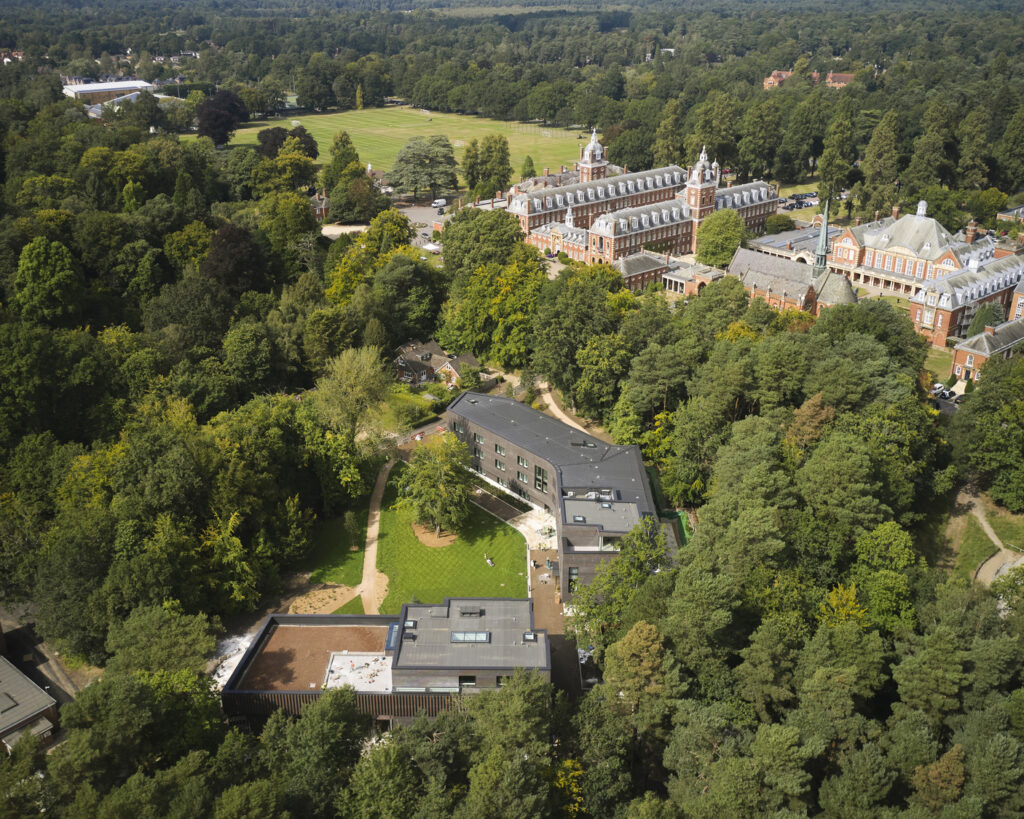
Submission by MICA Architects.
Being a good ancestor
Practice
1. Does the practice have a clearly stated purpose aligned with the planetary emergency? We are looking for a bold ambition here, and a practice culture which recognises the need for long-term thinking. For example, a strong mission, a theory of change, or a sustainability roadmap.
MICA was founded in 2017 but carries forward 30 years of responsible regenerative practice from the Rick Mather Architect era. The practice and our relationships as one to include a clear path to live in alignment with nature and to ensure the spaces created enhance, replenish and support our clients and the surrounding nature and environments. This is clearly stated on our website and demonstrated through our Benefit Corporation status achieved in 2024. A holistic sustainability design has been at the forefront of our design, and for the last 12 years we have measured our carbon footprint and reviewed each project in a holistic manner aligned to the RIBA 2030 best practice sustainability guidelines. Building on our commitment to Architects Declare in 2019, has followed with a sustainability roadmap in 2021, which externally audited annually in line with ISO 19001 and 14001 for continuous improvement. This scrutiny of every project embeds a clear aspiration for all.
2. Does the practice have a clear succession plan, which passes on ownership and protects the values and legacy of those who built and contributed to the practice? For example is the practice an employee owned trust.
MICA was born from a clear succession plan in its genesis from RMA, with continity of senior leadership. Since then, the leadership has evolved and grown, with key members of staff growing from architectural assistants to Associate Director positions, with discussions underway for future succession. Open discussions have been held to solicit employee views on the most equitable way of fostering the next generation of leadership and ownership of the practice, we near ten years of MICA. The fostering of talent is embedded through our internal mentorship scheme, with allows younger staff access to more mature architects to assist them in furthering their careers outside of the project environment.
3. Does the practice share research and knowledge for the benefit of society and the wider world? For example, you regularly carry out post occupancy evaluation and share information with others.
We share our knowledge and expertise in a multitude of ways. Post occupancy evaluations are recommended for every project, and the lessons learned shared with the relevant fields and clients on future projects; we contribute by mentoring though the WIA scheme, RIBA, other networks; we delight in sharing via lectures at various university and hosting work experience or internship opportunities for schools and universities with which we work, but also drawn from our local area in Camden, where we are committed to improving social mobility.
Our staff are also engaged in a number of voluntary positions with charities and local expert panels including as external examiners for universities, parochial church councils, and charities. Our team regularly attends universities across the country as visiting critics, bringing expertise from the industry directly to the classroom. All these activities are documented and recognised through our BCorp certification.
Project
1. Does the practice advocate for long-term thinking at the outset of projects? Do you initiate projects with long-term thinking and challenge the client on design life? Also, can the practice demonstrate that this approach has worked – with a shorter or longer design life, or an innovative approach to financing or payback period?
At MICA, we pride ourselves in becoming ambassadors for our clients. Through these long-term relationships, an open dialogue can be harnessed to challenge clients to think beyond immediate needs and adopt a long-term perspective in their projects, considering future generations and the planet.
We treat each project as a mini masterplan. This enables us to unlock the maximum capacity, shortening payback periods and in turn embed deliverable sustainability into the design. At Wellington College, we unlocked an old laundry site adjacent to the historic campus. This forgotten site was redeveloped to create new student accommodation in a new woodland character area. Given the short academic term, the careful space planning enabled the site to be used for out-of-term lets, dramatically decreasing the payback period. This financial benefit provided cost certainty for a sustainable approach to be brought to the forefront, resulting in a Cross-Laminated Timber and Passivhaus-principled building.
2. Do your projects take account of the future climate and the need for resilience? For example, do the projects demonstrate flexibility, design for adaptation, design for disassembly, non-deterministic solutions, or demountable structures.
As first principle, our projects appoint a ‘climate champion’ aiding designers consider the contextual sensitivity and focusing on low tech, energy efficient, low carbon solutions which in turn allow for truly flexible and adaptable spaces that are stand the test of time.
At the Woodland Quad development: a central energy strategy has been implemented. The energy centre, powered by an extensive ground-source heat pump array situated beneath the adjacent parade ground, delivers low-carbon heating and hot water to both the buildings and the existing Victorian campus. This initiative has allowed historically significant buildings to dramatically decrease their carbon footprint, ensuring long-term carbon reduction.
Celebrating the inherent craftsmanship and sustainable attributes of Cross-Laminated Timber (CLT). The adoption of CLT not only fosters a biophilic and welcoming environment conducive to student living and learning but also reduces the building’s embodied carbon footprint by 50% compared to traditional construction methods.
3. Do the majority of your projects go beyond mitigating negatives and towards optimising positives? For example, are they meeting or exceeding the RIBA 2030 Challenge.
With the majority of our clients working across multi asset estates, we pioneered MICA DeCarbon; an interactive tool for a deliverable estate wide Net Zero Strategy. Combining in-house mechanical and electrical (ME) expertise with architectural and conservation knowledge, MICA DeCarbon tool blends strategic assessments with real-time data. This approach was trialled at Wellington College, where a survey of 63 buildings factored in upgrades, assessed energy bills, and estimated costs. The result was a comprehensive picture of potential carbon savings bettering RIBA 2030, both in embodied carbon from the works and in operational carbon reductions post-refurbishment.
Co-evolving with nature
Practice
1. Does the practice use biophilia within the office or regularly host meetings and retreats in natural settings? For example do you have extensive planting within the office or rely on natural patterns and imagery for stress relief or quiet areas.
MICA embraces biophilia and its many benefits, creating meaningful connections to nature in our Camden High Street studio. Our terrace garden, a green retreat from city life, hosts lunches, meetings, and social gatherings, with meeting rooms opening directly onto it. Indoor plants, cared for by staff, and our regular canine visitors enrich the office atmosphere. Weekly team meetings provide space for collaborative reflection and planning, while bi-monthly social hours during the workday help maintain work-life balance. Seasonal away-days and CPD trips, including a spring domestic retreat and an autumn rail-accessible journey abroad, offer space for learning and team bonding. In 2024-25, staff participation in activities like sponsored runs for the Architects Benevolent Society, local litter-picking, and a MICA Music League has grown. Looking ahead, retreats to upcoming bucolic project settings, including in Wellington, and further research into natural materials will continue to deepen our connection with nature.
2. Can the practice share examples where it has considered nature in decision making? For example by having a nature proxy to encourage eco-centric decision making, using natural systems as inspiration for the company structure, recognising the seasonal nature of people’s capacity and workload or celebrating equinoxes and solstices together.
MICA respond to flexibilities in studio member preferences of working and seeks out ways for our practice to experience the natural world to subtly shape our ways of thinking and working. Many of our team members have families, and the school year inflects the seasonal change with members taking seasonal breaks and working remotely during holidays.
Our annual office trips have presented opportunities to spend time together as a practice outdoors. Whether as part of an architectural interest tour in a landscape setting, or rooftop dinner experiencing a late summer sunset, we all value the clarity and peace a different atmosphere can provide our minds in speaking with one another and thinking about our shared future.
We have recently invested in a new library of natural materials which is on display in our meeting room, ensuring that natural, recycled and circular materials are top of mind when making decisions.
3. Is the practice supporting nature locally and nationally? For example, does the practice support local gardens, gardeners, planting programmes, rewilding programmes or advocate for changes in legislation to protect nature.
MICA supports nature both locally and nationally: our team regularly participates in cleanup program in Camden, picking litter and improving the surroundings, particularly around the natural settings of St Martin’s Gardens, and the Regents Canal. We purchase all our plants and garden equipment from the local Camden Garden Centre.
On a national level, we recently completed the High Density X Urban Greening study for the London Legacy Development Corporation. The research examines how to best deliver urban greening in high density residentially led developments through the analysis and review of projects delivered in London, the UK, and the world. This report won an award at the Planning Awards, and concludes with a list of recommendations for a variety of audiences including those: applying for planning permission, planning officers and clients. It also demonstrates meaningful, sustainable, and innovative solutions that can be used to increase UGF in high density residential developments, which has changed the planning context for local authorities.
Project
1. Can the practice demonstrate projects which strive to match the performance of a mature ecosystem? As a minimum this would mean achieving biodiversity net gain.
MICA have been at the forefront of policy briefing in relation to green infrastructure and net zero ambition MICA were employed by the London Legacy Development Corporation to undertake research into Urban Greening Factor (UGF). The research examines how to best deliver urban greening in high density residentially led developments through the analysis and review of projects delivered in London, the UK, and the world.
The study concludes with a list of recommendations for a variety of audiences including those: applying for planning permission, planning officers and clients. It also demonstrates meaningful, sustainable, and innovative solutions that can be used to increase UGF in high density residential developments.
2. Is the practice working on material stewardship? For example, evidence could be shown through repeated use of low carbon materials, extensive material libraries and research or publications supporting responsible use of materials and elimination of waste.
We believe the term “material stewardship” means “using less to do more.” MICA’s in-house research explores how improved material specification can reduce the layers of products often specified to achieve NBS or performance criteria. An example of this is at the Sixth Form Centre at Wellington College. Working alongside Sandy Brown Acoustics, engineers HRW, and Pliteq, we tested and delivered a pioneering construction build-up using recycled rubber matting and a 140 mm thick exposed CLT slab. This achieved the same acoustic performance standard as a traditional double plasterboard acoustic suspended ceiling on a concrete slab. The omission of ancillary structural ceiling systems, gypsum board, and concrete dramatically reduced not only the embodied carbon but also construction waste. Because CLT was prefabricated and the waste from each product was recyclable, supporting the elimination of landfill waste.
3. Do the majority of projects demonstrate the use of biologically-inspired approaches such as Bioregionalism, Biophilia, Biomimicry, Ecomimicry (also referred to as Ecosystems Thinking, Industrial Ecology or Industrial Symbiosis) or BioTRIZ?
No.
Creating a just space for people
Practice
1. Does the practice have a progressive EDI policy and can you evidence many forms of diversity, which are welcomed and acknowledged, within the practice?
MICA has a progressive Equity, Diversity and Inclusion policy, which includes training for mangers to ensure fair treatment. We now have gender balance at senior leadership level and are working hard to ensure that gender parity remains at all levels, and improve other forms of diversity. We have an annual review and set new targets. All within the practice welcome the policy and ensure diversity is met in teams and a platform is created where all can contribute and speak up. RMA was founded by a gay man, and we carry this history proudly as a consistent donor to Stonewall and other LGBTQ+ causes. We constantly calibrate our teams to ensure that we maintain a good diversity of voices, and remind younger, less-experienced members that their voices and perspectives are valid and useful as a counterpoint to older viewpoints.
2. Does the practice operate a no overtime culture, meet the living wage consistently, and stipulate a fair salary ratio between staff of all levels?
MICA is a Living Wage Employer, which is monitored annually and externally audited. We scrutinise our gender pay gap at each salary review and generally find that we compare favourably to others in our cohort.
We are moving towards a culture of no overtime, and we ensure that every staff member accurately documents the hours that they work so that staffing of future projects is best informed by the reality of the past. Managers ensure that workloads are balanced and staff are free to speak up when they feel overloaded, and know that management is the solution, not overtime: checks by project architects with more junior staff, and also between directors and project architects seek to encourage effective efficiency, challenge programmes, and a more equitable and realistic spread of tasks. Where overtime is necessary, time in lieu is awarded on an agreed basis.
3. Does the practice support charities, community groups, social enterprises, action groups and others through pro-bono work, charitable giving or in-kind donations?
We are proud to be practice partners with the Architect’s Benevolent Society, supporting their work in promoting wellbeing, mental health, and financial support for individuals across the architectural profession. Through this partnership, we contribute to a culture of care and resilience within the built environment sector. In addition, our collaboration with Stonewall UK reflects our commitment to LGBTQ+ inclusion and equality in architecture. By championing inclusive workplace practices and supporting education and mentoring opportunities, we aim to help build a profession that reflects and supports the diversity of the communities we serve. We also host work experience students from a range of backgrounds, with a particular focus on young people from the local Camden community, to inspire and support the next generation of architects.
4. Does the practice publicly refuse to work with certain clients, suppliers or organisations on ethical grounds?
No.
Project
1. Do the projects demonstrate deep engagement with local stakeholders and end users? For example, is there evidence that your project engagement goes beyond consultation towards co-design?
At MICA, we advocate for our clients, stakeholders, and end-users. While balancing these diverse perspectives can be challenging, we embrace it to deliver meaningful architecture. Our co-design approach is collective from the outset, and we invest time in understanding our audience.
For the London Legacy Development Corporation (LLDC), MICA was commissioned to undertake a Density Study. This study was designed to provide a publicly accessible tool for the Local Planning Authority, developers proposing development, and local communities engaging with high-density development schemes in the planning process.
Understanding that LLDC was devolving its powers back to local boroughs, local stakeholder engagement was essential, and case study research was a key tool for gathering firsthand insights. This innovative project serves as an example for local authorities nationwide, demonstrating publicly accessible tools that convey complex information in a coherent and legible format.
2. Do your projects create connected and resilient places which positively contribute to their neighbourhoods and allow equality of access? For example, do your projects create economic opportunity, retain value locally and generate social value?
One of our principle design agendas is to design places and spaces that ‘give back to the street’. This enables economic opportunity through improving neighbourhood amenity and access. An example of this is our Dicot Housing scheme for South Oxfordshire District Council. This is a mixed-use Passivhaus & EnerPHit scheme of affordable housing and Class E development on the site of existing and derelict two-storey shopfront buildings on The Broadway. The sustainable redevelopment of this important town centre site sets a positive precedent and marker towards attaining objectives set out in the Garden Town initiative and future strategic growth of Didcot. A refurbished historic building and contemporary new building bring the Broadway a renewed and occupied site.
3. Do the majority of your projects promote equity in society, and consider all people, not only the building inhabitants? For example, do your projects show due regard for workers within the supply chain and take active steps to avoid modern slavery?
We aim to promote equity in society for the majority of our projects. We consider user, wider concept, potential future users, those impacted by the space and the wider supply chain. This is underlined by our B-corp status. At Wellington College this ranged from ensuring the supply chain, where possible, workers and material is tracked to a local source within a 100 mile radius.