
Submission by Grimshaw.
Being a good ancestor
Practice
1. Does the practice have a clearly stated purpose aligned with the planetary emergency? We are looking for a bold ambition here, and a practice culture which recognises the need for long-term thinking. For example, a strong mission, a theory of change, or a sustainability roadmap.
This is taken from our website, www.grimshaw.global.
“Across four decades our holistic approach to sustainable development has encompassed the full scale of economic, social and environmental impacts. Today more than ever we know that an increasing population and finite resources present a unique challenge, and our response addresses ways to move towards a regenerative environment that connects carbon, water, biodiversity, energy, a circular economy and health and wellbeing to create a resilient and adaptable way of life”.
2. Does the practice have a clear succession plan, which passes on ownership and protects the values and legacy of those who built and contributed to the practice? For example is the practice an employee owned trust.
The partners of the practice have a succession plan in place which focusses on maintaining the integrity of the practice and its values. The Chairman and Group Managing Partner are the owners of the plan.
3. Does the practice share research and knowledge for the benefit of society and the wider world? For example, you regularly carry out post occupancy evaluation and share information with others.
www.minoro.org a free online platform is an example of sharing our work in designing net zero carbon new and existing buildings that now is used in over 85 countries with over 5200 users. To learn more, please visit: https://grimshaw.global/sustainability/
Project
1. Does the practice advocate for long-term thinking at the outset of projects? Do you initiate projects with long-term thinking and challenge the client on design life? Also, can the practice demonstrate that this approach has worked – with a shorter or longer design life, or an innovative approach to financing or payback period?
We challenge the project concept, its justification and then whether existing assets can be re-purposed. We have examples like the award-winning Bath Schools of Art and Design (originally designed in the 1970s as a furniture factory) and Engineering Building for the University of Cambridge. Both projects deploy circular design principles and product life extension.
Learn more at: https://grimshaw.global/sustainability/civilengbuildingcs/ and https://grimshaw.global/sustainability/bath-schools-of-art-and-design-case-study/
2. Do your projects take account of the future climate and the need for resilience? For example, do the projects demonstrate flexibility, design for adaptation, design for disassembly, non-deterministic solutions, or demountable structures.
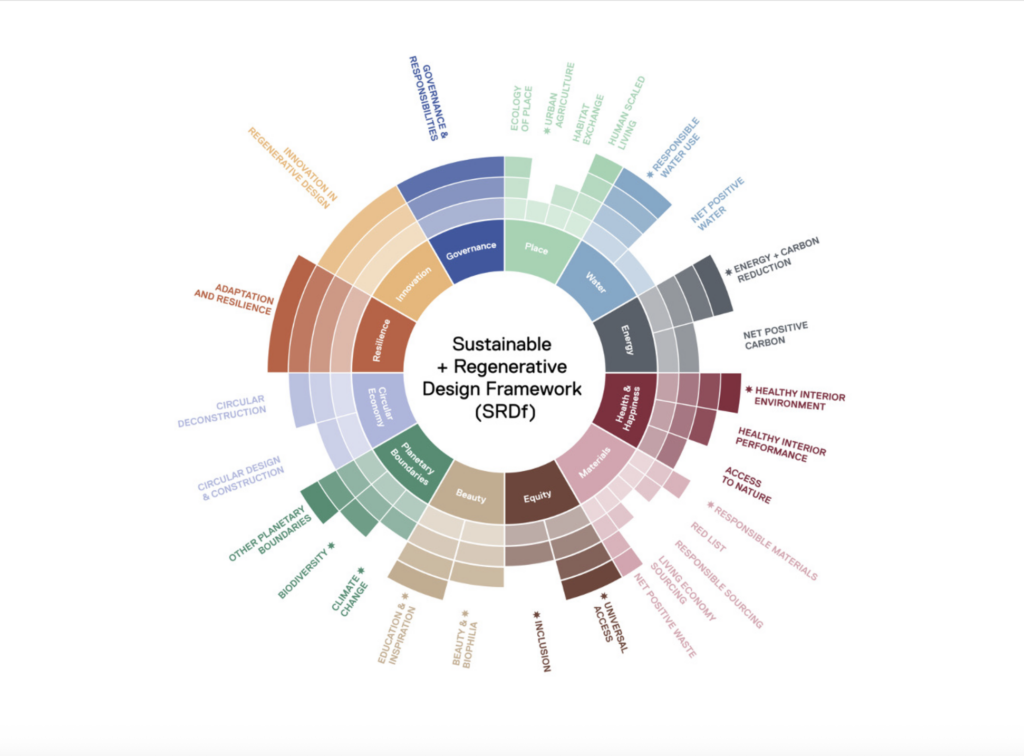
As examples above show we are designing for flexibility. For our transport and infrastructure designs with long design lives climate, resilience is important. Our projects implement a sustainable and regenerative design framework which includes adaptation and resilience.
3. Do the majority of your projects go beyond mitigating negatives and towards optimising positives? For example, are they meeting or exceeding the RIBA 2030 Challenge.
Our in-house net zero carbon framework is aligned to 1.5 Paris Agreement and features RIBA 2030 Challenge as well as other commitments we are signed up to, such as Architecture 2030. We mandate www.minoro.org as our carbon management process to deliver reduced whole life carbon emissions.
Co-evolving with nature
Practice
1. Does the practice use biophilia within the office or regularly host meetings and retreats in natural settings? For example do you have extensive planting within the office or rely on natural patterns and imagery for stress relief or quiet areas.
Yes, in all our offices we have natural planting and also use colours, patterns and materials to support health and well-being of our studios. Our recent fit-out of our new leased Melbourne studio really explores these themes.
For more info: https://www.indesignlive.com/projects/renewed-studio-grimshaw
2. Can the practice share examples where it has considered nature in decision making? For example by having a nature proxy to encourage eco-centric decision making, using natural systems as inspiration for the company structure, recognising the seasonal nature of people’s capacity and workload or celebrating equinoxes and solstices together.
Examples include biomimicry of the local trees in Dubai desert for inspiration of the award winning Terra Pavilion: the inspiration for the Main Roof Canopy was the desert Ghaf Tree, a drought-tolerant tree which can remain green even in harsh desert environments, essential for the survival of animal and plant species alike. The Socotra dragon tree, native to an archipelago in the Arabian Sea, is the inspiration for elements of the main canopy, the Energy Trees, and the Water Trees. Its dichotomous branching and umbrella canopy produce dense shade preventing evaporation – a critical adaptation to regions arid conditions.https://grimshaw.global/sustainability/expo-2020-sustainability-pavilion-case-study/
Biomimicry of the spindles of the Saguaro cacti found in the Tempe dessert of Arizona to inform facade design of the Walton Centre for Planetary Health at Arizona State University: The cactuses shield themselves from solar exposure with patterned deep-pleated skin.
See https://grimshaw.global/sustainability/asu-walton-center-for-planetary-health-case-study/
3. Is the practice supporting nature locally and nationally? For example, does the practice support local gardens, gardeners, planting programmes, rewilding programmes or advocate for changes in legislation to protect nature.
Grimshaw are members of Business for Nature supporters and through signing up to Architects Declare we recognise the biodiversity crisis. On our designs we advocate natural planting schemes. We are also involved in designing botanic gardens such as Oman Botanic Gardens and Oxford Botanic Gardens, so they can become important genetic banks for future generations.
Project
1. Can the practice demonstrate projects which strive to match the performance of a mature ecosystem? As a minimum this would mean achieving biodiversity net gain.
In truth we have limited exposure to this on buildings but on our large infrastructure projects, commitments are made to net biodiversity gain. Our regenerative designs have NBG as an important component.
2. Is the practice working on material stewardship? For example, evidence could be shown through repeated use of low carbon materials, extensive material libraries and research or publications supporting responsible use of materials and elimination of waste.
We produce a series of insight papers. Last year, one edition focused on Healthy Materials where we explain the issues and resources available so projects can make better informed choices. Linked to our approach to whole life carbon, we seek to use low carbon materials and reduce waste.
3. Do the majority of projects demonstrate the use of biologically-inspired approaches such as Bioregionalism, Biophilia, Biomimicry, Ecomimicry (also referred to as Ecosystems Thinking, Industrial Ecology or Industrial Symbiosis) or BioTRIZ?
No.
Creating a just space for people
Practice
1. Does the practice have a progressive EDI policy and can you evidence many forms of diversity, which are welcomed and acknowledged, within the practice?
Our work is underpinned by a committed, structured, and measured approach to equality, diversity, and inclusion (EDI), supported by robust policies applied to all employees, subconsultants, and contractors. As the lead consultant, Grimshaw ensures that these policies and their aligned actions are managed and measured through our 8-Point Diversity Action Plan. This plan fosters a culture that values diversity and inclusion across our workforce, company culture, client base, and projects.
2. Does the practice operate a no overtime culture, meet the living wage consistently, and stipulate a fair salary ratio between staff of all levels?
As a London Living Wage Employer, we are committed to fair pay and economic inclusivity. We continue to track and strive for improvement in closing the gender pay gap, working in collaboration with RIBA and the wider industry to support inclusivity and inspire women. To drive business action, we support employee-led groups, including a Women in Architecture group, while also leading the Architects Mental Health Wellbeing Forum.
Our focus on lifelong learning is reflected in our 1:1 employee mentoring program and the hosting of an annual Diversity Week, which explores topics such as gender, race, social mobility, neurodiversity, and unconscious bias. We actively promote flexible and hybrid working, ensuring recognition and accommodation of the needs of individuals with disabilities and neurodiversity. To further strengthen inclusivity within the workplace, our Studio EDI management framework incorporates unconscious bias awareness training, reinforcing a culture of equity and belonging.
3. Does the practice support charities, community groups, social enterprises, action groups and others through pro-bono work, charitable giving or in-kind donations?
In addition to supporting a variety of charities, we established the Grimshaw Foundation to further our social impact. The Foundation focuses on increasing access to architecture and design careers for young people, particularly those from underrepresented backgrounds. Through workshops, mentoring and educational resources, it addresses gender, social, and economic equity by helping students explore creative career paths and navigate routes into further education. This reflects our wider commitment to using our platform and resources to drive positive change beyond the built environment.
4. Does the practice publicly refuse to work with certain clients, suppliers or organisations on ethical grounds?
We have a examples of clients we have refused to work with on these grounds and when publicly asked we have described this position. Examples include when the country and very little ambition to transition away from fossil fuels. We have also found that working with clients with low awareness of regenerative design we can help support their decision making in a very pro-active way.
Project
1. Do the projects demonstrate deep engagement with local stakeholders and end users? For example, is there evidence that your project engagement goes beyond consultation towards co-design?
This can be evidenced more in our urban design and master planning. There does appear a trend for co-design especially in recognition of indigenous cultures, such as “caring for country” in Australia. The same is true in university building designs as the teaching staff are heavily involved. Going beyond consultation requires a client to understand the benefits of so doing which we do promote.
2. Do your projects create connected and resilient places which positively contribute to their neighbourhoods and allow equality of access? For example, do your projects create economic opportunity, retain value locally and generate social value?
Generating social value is a big driver across all our designs regardless of typology or location. It is important for our clients and their investors, so in most cases we don’t need to make the case. However, the understanding of resilient place is more varied. The majority of projects across our portfolio seek connection for the community be that education, arts, leisure or transportation so one aspect of why we are asked to contribute is our understanding of these and how design facilitates a number of social benefits. Our recent award winning masterplan of Waterloo is a good example of this.
3. Do the majority of your projects promote equity in society, and consider all people, not only the building inhabitants? For example, do your projects show due regard for workers within the supply chain and take active steps to avoid modern slavery?
At Grimshaw, we are committed to promoting equity – not only for building users but for the wider community and all those involved in our projects. Stakeholder engagement is embedded in our design process, helping us identify opportunities to support social equity and set KPIs to measure impact. We recognise our responsibility across the full project lifecycle, including our supply chain. All new subconsultants complete our Pre-Appointment Questionnaire, confirming their modern slavery policies and ethical practices. This supports compliance with ISO 9001, ISO 14001, and CDM 2015 regulations. Beyond project work, the Grimshaw Foundation reflects our broader commitment to equity by enabling access to education and career opportunities in architecture and design, particularly for underrepresented groups.