
Submission by Cairn.
Being a good ancestor
Practice
1. Does the practice have a clearly stated purpose aligned with the planetary emergency? We are looking for a bold ambition here, and a practice culture which recognises the need for long-term thinking. For example, a strong mission, a theory of change, or a sustainability roadmap.
Over recent years the practice’s ethos has changed from having low-carbon design as one of our interests, to this becoming the dominant driver to practice. We are particularly focused on reuse projects. Those that we have had the chance to realise thus far have been small scale residential projects although we have a strong ambition to increase this scale. We are committed to innovating with the use of materials and methods of assembly to reduce and repair damage to the living world.
We were awarded the Environmental Leadership prize by New London Architecture in the 2024 Don’t Move Improve awards. We are excited to now be working on a school and youth centre to develop our approach on education projects.
2. Does the practice have a clear succession plan, which passes on ownership and protects the values and legacy of those who built and contributed to the practice? For example is the practice an employee owned trust.
No.
3. Does the practice share research and knowledge for the benefit of society and the wider world? For example, you regularly carry out post occupancy evaluation and share information with others.
We have spoken at events and published figures related to House Made by Many Hands (see below). Kieran teaches an environmentally focussed design unit at University of Edinburgh, which he sees as a form of activism. Kieran has published his experience of working and thinking about building sustainably, including:
https://drawingmatter.org/series/connor-street-made-by-many-hands/ and
https://www.thedeveloperlive.co.uk/opinion/opinion/little-green-lies-we-need-to-talk-about-low-carbon-construction
Project
1. Does the practice advocate for long-term thinking at the outset of projects? Do you initiate projects with long-term thinking and challenge the client on design life? Also, can the practice demonstrate that this approach has worked with a shorter or longer design life, or an innovative approach to financing or payback period?
House Made by Many Hands is the first building structure in the UK to specify low-carbon LC3 concrete, together with a hardwood frame in place of traditional steel, natural materials throughout and a rigorous policy of re-use and recycling for the interior. LC3 generates 30-40% less CO2 than Ordinary Portland Cement in production.
The project achieves a Lifetime Carbon figure 40% lower than if it had been built conventionally: 222 kgCO2e/sqm. This was achieved by minimising the use of steel, concrete and internal linings.
This home demonstrates how a Victorian house can be renovated and extended with a substantially reduced environmental impact, pioneering the use of low-carbon concrete and hardwood structure.
2. Do your projects take account of the future climate and the need for resilience? For example, do the projects demonstrate flexibility, design for adaptation, design for disassembly, non-deterministic solutions, or demountable structures.
House Made by Many Hands has a timber frame with precise joints and minimal use of steel for connections allows the structure to be fully demounted and reused at the end of its life. This crisp carpentry is offset against raw strata of hempcrete cast by hand in the walls.
https://cairnarchitects.com/work/house-made-by-many-hands/
Our nascent design for a school in central London have flexibility and resilience at their core.
3. Do the majority of your projects go beyond mitigating negatives and towards optimising positives? For example, are they meeting or exceeding the RIBA 2030 Challenge.
I believe so. We are trying to create a body of knowledge of how people might adapt their houses with a minimum of carbon. As well as House Made by Many Hands, we have recently completed projects that use mini screw piles to minimise concrete and preserve a mature tree, as well as another where rubble foundations were used – the first such application that we are aware of for a contemporary London extension.
Co-evolving with nature
Practice
1. Does the practice use biophilia within the office or regularly host meetings and retreats in natural settings? For example do you have extensive planting within the office or rely on natural patterns and imagery for stress relief or quiet areas.
Yes – we have extensive planting in our office. We go for walks alongside Water of Leith (Edinburgh studio) and Regents Canal (Hackney studio) most days.
2. Can the practice share examples where it has considered nature in decision making? For example by having a nature proxy to encourage eco-centric decision making, using natural systems as inspiration for the company structure, recognising the seasonal nature of people’s capacity and workload or celebrating equinoxes and solstices together.
No.
3. Is the practice supporting nature locally and nationally? For example, does the practice support local gardens, gardeners, planting programmes, rewilding programmes or advocate for changes in legislation to protect nature.
No.
Project
1. Can the practice demonstrate projects which strive to match the performance of a mature ecosystem? As a minimum this would mean achieving biodiversity net gain.
No.
2. Is the practice working on material stewardship? For example, evidence could be shown through repeated use of low carbon materials, extensive material libraries and research or publications supporting responsible use of materials and elimination of waste.
We have repeatedly used low carbon materials in our projects, including timber frames instead of steel and the first use of LC3 concrete in the UK. We have explored the use of alternatives to concrete substructure, including mini screw piles, rubble trenches and raised timber floors.
We have an extensive low carbon material library.
A large part of our teaching practice at the University of Edinburgh is focussed on raising students’ awareness of responsible ways to build.
3. Do the majority of projects demonstrate the use of biologically-inspired approaches such as Bioregionalism, Biophilia, Biomimicry, Ecomimicry (also referred to as Ecosystems Thinking, Industrial Ecology or Industrial Symbiosis) or BioTRIZ?
No.
Creating a just space for people
Practice
1. Does the practice have a progressive EDI policy and can you evidence many forms of diversity, which are welcomed and acknowledged, within the practice?
We have a progressive EDI policy in place.
We are currently only 2 members of staff in size, so diversity is limited. Both members of staff currently are male, and one identifies as LGBTQ.
2. Does the practice operate a no overtime culture, meet the living wage consistently, and stipulate a fair salary ratio between staff of all levels?
We do not work overtime. We pay over the published industry standards, (albeit only for 2 members of staff!)
3. Does the practice support charities, community groups, social enterprises, action groups and others through pro-bono work, charitable giving or in-kind donations?
We have carried out pro-bono work for St Joseph’s Hospice in Hackney, assisting with an estate strategy and conducting ideas-gathering sessions with residents. We have also carried out pro-bono site studies for CHOISS co-housing group in Edinburgh, as they try to find a site for their community to progress.
We have recently been working the YMCA Youth Groups in a socially disadvantaged area of Leith, run-in workshops with children as part of the Community Structure project.
4. Does the practice publicly refuse to work with certain clients, suppliers or organisations on ethical grounds?
No sure what “publicly” means in this context. We explicitly would not work with any organisation investing in fossil fuels or in states with poor human rights. The small size of our projects to date has not led us to make a public statement to this effect though.
Project
1. Do the projects demonstrate deep engagement with local stakeholders and end users? For example, is there evidence that your project engagement goes beyond consultation towards co-design?
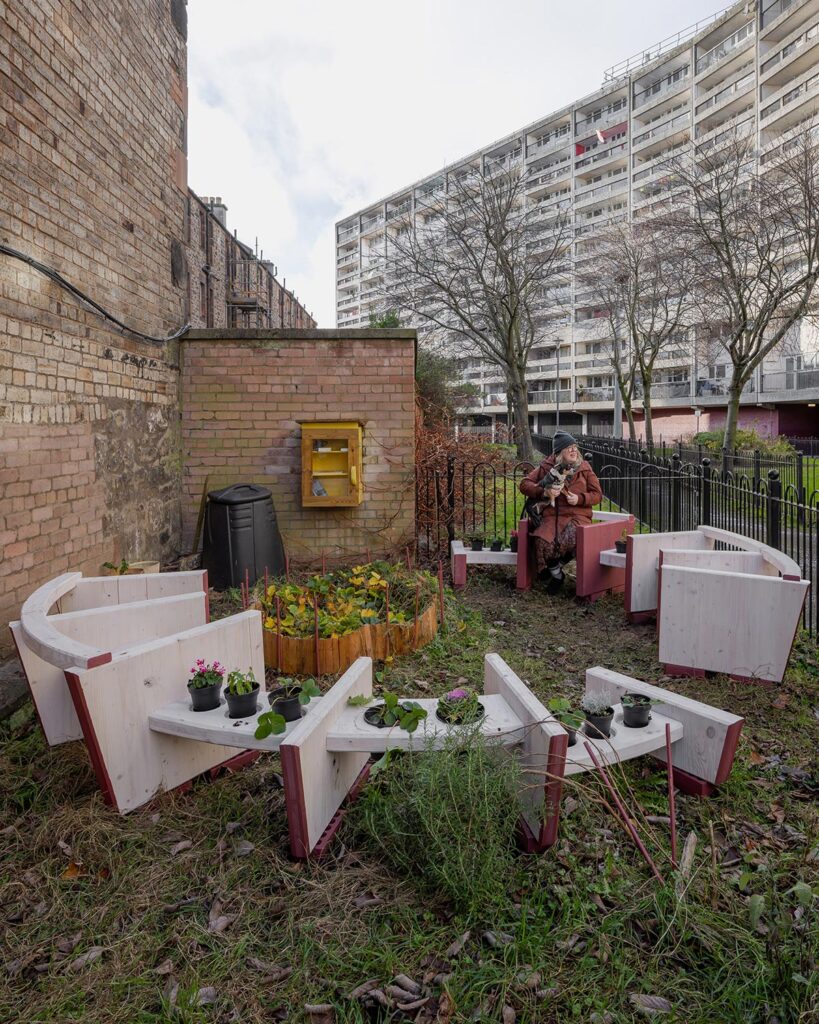
Our work with residents of Cables Wynd House social housing in Leith, in partnership wit our students from University of Edinburgh, involved a deep process of engagement to design and build a series of timber community structure in the grounds of the estate. This included resident workshops, running a stall at the estate summer fair and organising sessions with the children to paint the structures with their designs.
In our work creating an estate masterplan for St Joseph’s Hospice in Hackney, a number of workshops were held to establish the client ambitions and allow the residents to assist in the brief development, following our space utilisation survey. To open discussions to those who could not attend, postcards were prepared to allow all staff and patients to contribute. A scale model with ‘Suggestion Trees’ was provided allowing residents to contribute their thoughts. This allowed for suggestions to be pin-pointed to specific locations on the model and opened up the dialogue to a wide range of stakeholders. The resulting strategy is being implemented in stages.
2. Do your projects create connected and resilient places which positively contribute to their neighbourhoods and allow equality of access? For example, do your projects create economic opportunity, retain value locally and generate social value?
Our Leith Community Structure project was intended to help the community enjoy ground of their estate and make things just a little bit easier. These included sheltered places for elderly residents to wait for a pick-up and platforms designed for teenage girls to sit and talk and observe.
3. Do the majority of your projects promote equity in society, and consider all people, not only the building inhabitants? For example, do your projects show due regard for workers within the supply chain and take active steps to avoid modern slavery?
We have not had the opportunity to work on projects at a large scale. Our domestic projects always consider the contractors who will be working with the materials, leading to designs with timber and natural insulations. In the Made by Many Hands project we worked closely with the contractors as they learnt new skills with materials that created a far more pleasant site for them, with fewer irritants in the air. The client, architect and contractor joined in with hand-casting the hempcrete walls.