
Submission by AWW.
Being a good ancestor
Practice
. Does the practice have a clearly stated purpose aligned with the planetary emergency? We are looking for a bold ambition here, and a practice culture which recognises the need for long-term thinking. For example, a strong mission, a theory of change, or a sustainability roadmap.
AWW is committed to making a positive impact. Our goal is to deliver quality architecture and interior design, achieving this through: Creating a net gain environmental impact; Enhancing people’s quality of life; Building relationships and developing partnerships for delivery that support our core values and improve our ability as designers and advocators to effect positive change.
AWW is net-zero carbon (Scope 1, 2 and some 3 emissions), with a commitment to a science-based target carbon reduction through the SME Climate Hub. We are a member of the United Nations Race to Zero campaign and a signatory of Architects Declare and the RIBA 2030 Climate Challenge. We publish our Carbon Reduction Report and Social Impact Report annually and continually strive towards our ambitious target to be zero carbon ready in everything we do in 2025, before making a collective shift in mindset away from ‘sustainable’ towards a regenerative design model.
2. Does the practice have a clear succession plan, which passes on ownership and protects the values and legacy of those who built and contributed to the practice? For example is the practice an employee owned trust.
We have always prided ourselves on working as a collective, and in 2023 we transitioned into operating as an Employee Owned Trust (EOT). In becoming an EOT, we can further enact on our mission to effect positive change.
3. Does the practice share research and knowledge for the benefit of society and the wider world? For example, you regularly carry out post occupancy evaluation and share information with others.
In 2018 we set up AWW Co-Lab, a collaborative research platform, to help develop an understanding of regenerative design. This initiated engagment in several research projects and build partnerships with like-minded businesses. ‘Co-Lab’ has now been absorbed back into the company and its legacy is evident in our everyday practice. We are currently involved in two main research projects: Carbon Artifacts, a socio-material approach to low and net zero carbon building design from concept to handover (led by University of Reading); BuildZero, transforming the UK’s buildings for zero material extraction, zero carbon & zero waste (led by University of Sheffield). Involvement in these projects allows us to grow our understanding of complex socio-environmental issues, and apply this learning to practice.
We measure the Social Value Impact of our projects through P.O.E and use this data to improve project impact for building occupants and stakeholders, and to share our learning.
Project
1. Does the practice advocate for long-term thinking at the outset of projects? Do you initiate projects with long-term thinking and challenge the client on design life? Also, can the practice demonstrate that this approach has worked with a shorter or longer design life, or an innovative approach to financing or payback period?
Embedding circular economy into building design is key to a regenerative construction industry and AWW are advocates for this on projects.
The AWW approach is: Advocate building re-use; Agree CE strategy at Stage 1; All relevant projects have a CE method statement at RIBA Stage 2/3; Design for disassembly, and adopt ‘Building in Layers’, communicating the disassembly strategy through the life of the project; engage in industry research on CE.
An example is our recently completed Mary Ward Centre project where many of the project successes can be attributed to the adoption of a CE mindset through the building lifecycle stages, from inception through to occupation; Deep retrofit and reuse of the existing structure, 90% diversion of waste from landfill, 100% of loose furniture procured through a circular procurement scheme, 100% of ITC procured through 2nd life IT scheme including donating all outdated IT to eliminate waste.
2. Do your projects take account of the future climate and the need for resilience? For example, do the projects demonstrate flexibility, design for adaptation, design for disassembly, non-deterministic solutions, or demountable structures.
This is described in Q1:
Embedding circular economy into building design is key to a regenerative construction industry and AWW are advocates for this on projects
The AWW approach is: Advocate building re-use; Agree CE strategy at Stage 1; All relevant projects have a CE method statement at RIBA Stage 2/3; Design for disassembly, and adopt ‘Building in Layers’, communicating the disassembly strategy through the life of the project; engage in industry research on CE.
3. Do the majority of your projects go beyond mitigating negatives and towards optimising positives? For example, are they meeting or exceeding the RIBA 2030 Challenge.
Currently the industry is still chasing ‘net-zero’, both in terms of definition and measurement. Therefore our approach is two-fold: 1. engage in regenerative thinking through research/advocation, whilst trying hard to get to ‘zero’ first. 2. Push towards optimising positives where we have most influence. For us this meant a decision to become leaders in social value, in line with our mission to create a positive impact to people’s lives: AWW are the first architectural practice to achieve the Social Value Quality Mark, recognition of our commitment to creating a positive ESG impact.
As signatories of the RIBA 2030 challenge we have been recording our progress and we think we are on target to achieve net zero operational ‘ready’ on all our projects within 2025, but can’t be sure of this as so much depends on external factors including clarity on legislation and definitions around zero impact and positive impact.
Co-evolving with nature
Practice
1. Does the practice use biophilia within the office or regularly host meetings and retreats in natural settings? For example do you have extensive planting within the office or rely on natural patterns and imagery for stress relief or quiet areas.
Our in house Interior Design team have a great deal of experience in designing biophilic environments and have brought their expertise to bear on the AWW offices, with planting and quiet areas provided. The workplaces are agile, meaning staff can work in whichever setting is most helpful to them and the task they are carrying out – from collaborative areas to individual places for deep concentration, with planting running throughout. The Interior Design Team carry out sensory audits on projects and within the office, ensuring that the spaces are inclusive for all.
2. Can the practice share examples where it has considered nature in decision making? For example by having a nature proxy to encourage eco-centric decision making, using natural systems as inspiration for the company structure, recognising the seasonal nature of people’s capacity and workload or celebrating equinoxes and solstices together.
As an EOT, AWW has a democratically elected EOT Council, with all staff voting for their representatives. The Council listens to and supports staff with any issues raised: this help supports a healthy company ecology where the seeds of ideas can be safely planted on and nurtured, not just by the Board but by anyone at any level. As a family-friendly company, AWW supports the seasonal nature of people’s capacity and supports and encourages mental health and well-being through a number of ways facilitated through group activities, a dedicated mental health professional and our internal social value team.
3. Is the practice supporting nature locally and nationally? For example, does the practice support local gardens, gardeners, planting programmes, rewilding programmes or advocate for changes in legislation to protect nature.
The practice supports staff involvement in support for nature, and recently this has included staff involvement planting hedgerow to extend a wildlife corridor in south Bristol.
Following an in-depth gap analysis on our ESG impact potential as a practice, our current focus is to support charities and schemes that help to reduce crime in our local cities. To this effect we have recently partnered with Young Bristol and Safer London and are looking at ways to support both charities. We are anticipating that there will be opportunities through these partnerships to support local gardens with the mutual aims of environmental gain and helping to support mental health.
AWW offset our remaining GHG emissions through Temwa. Based in Bristol (impact internationally) there are 3 strands to the scheme: 1. Community-led tree planting, 2. Supporting farmers and households to plant fruit producing trees, 3. Helping to protect existing forests.
Project
1. Can the practice demonstrate projects which strive to match the performance of a mature ecosystem? As a minimum this would mean achieving biodiversity net gain.
A recent example is Brunswick Wharf regeneration project in Devon, where the project goes beyond legislation and achieves 110.33% biodiversity net gain.
We find we are limited in our capacity to create a substantially positive ecosystem impact on our projects as we don’t provide landscape or ecology services, and many of our projects are individual buildings in urban areas. We are aware of this limitation and are looking at how we can create more positive impact, through extending the services we offer and the types of projects that we do. One way we plug this gap is through volunteering and charity work where we can engage with local projects supporting biodiversity in the city. A recent example is our in-kind support of a venture to plant hedgerow to extend a wildlife corridor in Bristol.
2. Is the practice working on material stewardship? For example, evidence could be shown through repeated use of low carbon materials, extensive material libraries and research or publications supporting responsible use of materials and elimination of waste.
In 2018 AWW engaged in our first research project on circularity potential in the built environment. This then led to further research projects with university partners across similar themes with regards to material stewardship.
BuildZero is the latest project we are involved with, through our portfolio of retrofit projects. The focus of the research is to establish whether the UK can create a circular construction industry and eliminate the import of virgin materials into the building lifecycle.
We also use embodied carbon analysis software on our projects to guide the design decisions around material use, and help to quantify and more fairly assess the impact of team decisions alongside other performance and cost factors.
3. Do the majority of projects demonstrate the use of biologically-inspired approaches such as Bioregionalism, Biophilia, Biomimicry, Ecomimicry (also referred to as Ecosystems Thinking, Industrial Ecology or Industrial Symbiosis) or BioTRIZ?
No.
Creating a just space for people
Practice
1. Does the practice have a progressive EDI policy and can you evidence many forms of diversity, which are welcomed and acknowledged, within the practice?
AWW is committed to building an organisation that makes full use of the talents, skills, experience, and different cultural perspectives available in a multi- ethnic and diverse society, and where people feel they are respected and valued, and can achieve their potential regardless of race, colour, nationality, national or ethnic origins, sexual orientation, gender, disability or age.
AWW follows the recommendations and guidance of the Equality and Human Rights Commission, in all our employment policies, procedures and practices, and in dealing with customers and members of the public
Our workplaces are fully accessible and take into account both physical challenges and any neurodiversity.
2. Does the practice operate a no overtime culture, meet the living wage consistently, and stipulate a fair salary ratio between staff of all levels?
AWW supports equal opportunities in employment and deems that male and female staff, regardless of their ethnicity, age or disability should receive equal pay for the same or broadly similar work, for work rated as equivalent and for work of equal value. AWW aims to avoid unfair discrimination and to reward fairly the skills, experience and potential of all staff.
AWW operates a pay system which is transparent, based on objective criteria and free from gender bias, regardless of race or disability. We pay the Living Wage as a minimum.
We have engendered a no overtime culture through careful management and accepting that overtime is almost always foreseeable. Therefore when overtime is looking likely this is red-flagged and discussed with the project director to find an alternative solution. Sometimes overtime can’t be avoided and this is either paid or TOIL is arranged.
3. Does the practice support charities, community groups, social enterprises, action groups and others through pro-bono work, charitable giving or in-kind donations?
As part of our Social Value Quality Mark accreditation, we pledge to undertake voluntary hours, both to support VCSEs and to provide business advice to MSMEs. Last year, we achieved 133% of our pledged voluntary hours to support VCSEs (an annual social value impact of £863.43) and 450% of our pledged staff hours of business advice to VCSEs and MSMEs (an annual social value impact of £22,725). (Figures aligned to HACT, Wellby and National TOMs.)
4. Does the practice publicly refuse to work with certain clients, suppliers or organisations on ethical grounds?
AWW is the first architectural practice to achieve the Social Value Quality Mark Silver. As part of this, we have a set of pledges and KPI’s which we report against annually. We actively review our value chain including clients, suppliers and other partner organisations and if we find they do not uphold the same high ethical standards, we do not work with them. Last year, we substituted two suppliers due to reported mistreatment of staff.
Project
1. Do the projects demonstrate deep engagement with local stakeholders and end users? For example, is there evidence that your project engagement goes beyond consultation towards co-design?
As part of our resilient communities social value pledge, we are committed to doing more work with VCSEs, especially when they are embedded in our projects. For the Mary Ward Centre project, we continue to be involved after project completion. 97.34% of those who completed Post Occupancy Evaluations identified that the building supported social engagement.
We are experts at translating the thoughts and aspirations of key stakeholders into architectural solutions, whilst ensuring everyone’s voice is heard, and decisions are made openly and transparently within a rigorous format.
Our successful partnerships are based on a close working relationship between all parties and a willingness to work in an open and collaborative way to achieve buildings that fully meet the needs of the end users, tailored to the budget constraints determined at the outset of the project.
This year AWW has been shortlisted for the AJ100 Community Impact Award.
2. Do your projects create connected and resilient places which positively contribute to their neighbourhoods and allow equality of access? For example, do your projects create economic opportunity, retain value locally and generate social value?
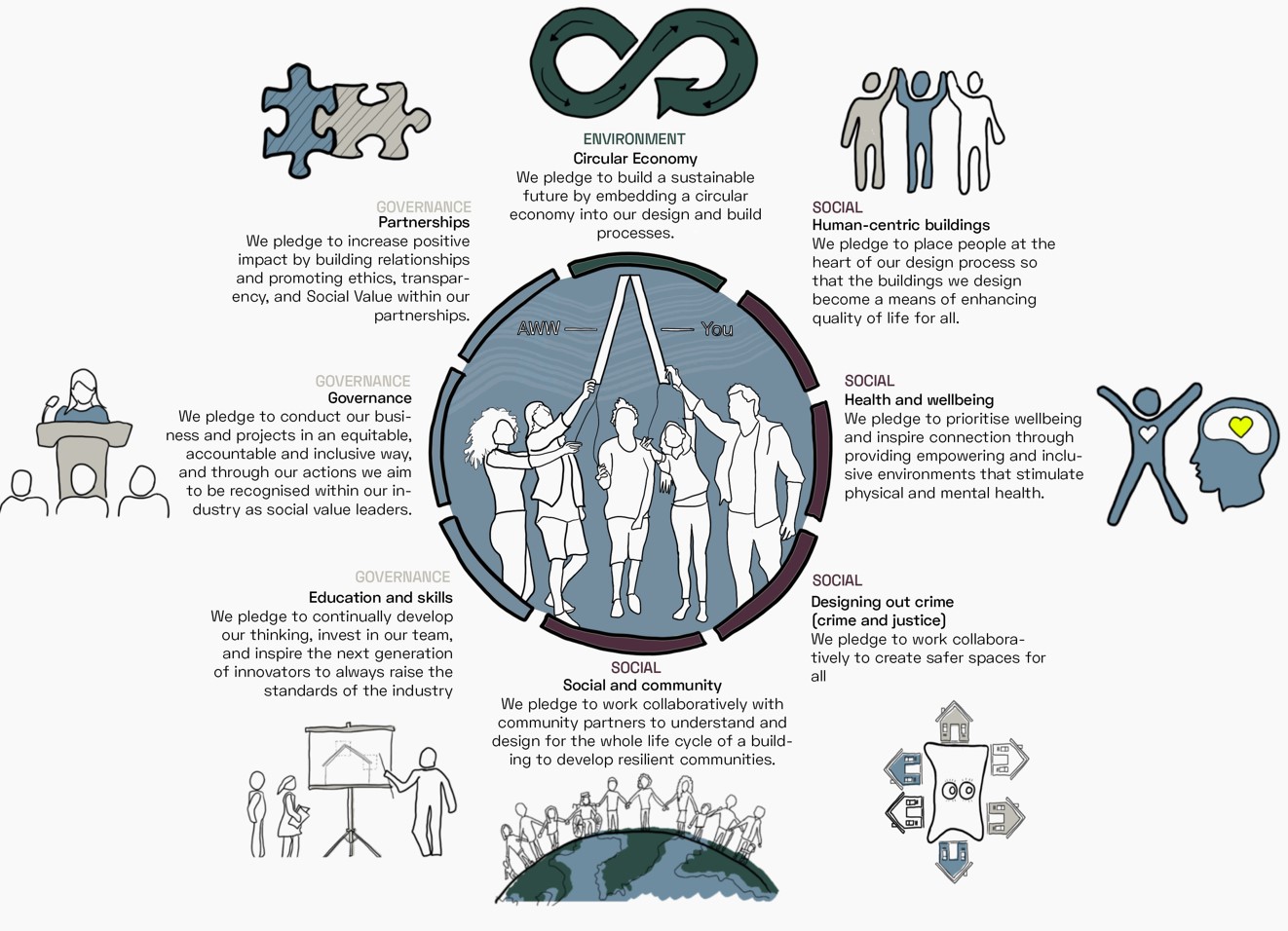
As Architects and Interior Designers, we have a specific impact on the built environment and how our projects, supply chain and the process we engage with positively contribute to society. As part of our Social Value Quality Mark Silver, we uphold our pledge to promote social innovation and develop healthier, safer and more resilient communities. This includes the creation of economic opportunity and retention of value locally: we fully support the cities in which we live and work.
Our post-occupancy evaluation of one of our projects local to our Bristol office, The Park in Knowle West, Bristol, demonstrated that £4.5m of added social value impact was generated through the project lifecycle stages 1-7. Examples of where impact was made included: Over 100 hours of time spent working with local schools, and a measured 7.4% reduction in crime within 1 mile of the site.
3. Do the majority of your projects promote equity in society, and consider all people, not only the building inhabitants? For example, do your projects show due regard for workers within the supply chain and take active steps to avoid modern slavery?
We work to uphold our social value pledge to prioritise wellbeing and inspire connection on all our projects, through providing empowering and inclusive environments that stimulate physical and mental health.
AWW endeavours to ensure that modern slavery and human trafficking is not taking place within our directly employed workforce or any of our value chain. We have a zero-tolerance approach to modern slavery and human trafficking and are committed to acting ethically and with integrity in all our business dealings and relationships and will not knowingly support or deal with any business involved in slavery or human trafficking.