
Submission by Austin Design Works Ltd
Being a good ancestor
Practice
1. Does the practice have a clearly stated purpose aligned with the planetary emergency? We are looking for a bold ambition here, and a practice culture which recognises the need for long-term thinking. For example, a strong mission, a theory of change, or a sustainability roadmap.
Our mission is to have a positive impact on nature and the communities in which it works and its vision is a world in which collaborative, thoughtful design solutions can enable a better environment for all.
Low energy construction is of the highest importance to us. We use our expertise to create buildings that require minimal energy to construct and run whilst also creating healthy and comfortable internal environments. Becoming a B Corporation in 2024 means that we are counted among businesses that are leading a global movement for an inclusive, equitable, and regenerative economy.
We intend to hit the climate 2030 targets set by RIBA with the projects that we undertake; we are also signatories of Architects Declare and the Better Business Act.
By promoting building products, services and professional bodies that match our values with regards to Passivhaus, Biodiversity Net Gain and Net Carbon Zero, we are consistently reinforcing our commitment to addressing climate change.
2. Does the practice have a clear succession plan, which passes on ownership and protects the values and legacy of those who built and contributed to the practice? For example is the practice an employee owned trust.
No.
3. Does the practice share research and knowledge for the benefit of society and the wider world? For example, you regularly carry out post occupancy evaluation and share information with others.
All of our projects are evaluated and we use this information to raise awareness of low energy construction as well as Biodiversity Net Gain, collaborating with Gloucestershire Nature + Climate Fund and also by delivering talks to developers, end users, planners and Universities across the South West of England. The practice delivers BNG CPD talks to architects, and provides visiting critics to University of the West of England and University of Gloucestershire.
Project
1. Does the practice advocate for long-term thinking at the outset of projects? Do you initiate projects with long-term thinking and challenge the client on design life? Also, can the practice demonstrate that this approach has worked with a shorter or longer design life, or an innovative approach to financing or payback period?
We state within all of our fee proposals that as signatories of Architects Declare and RIBA’s 2030 Climate Challenge are very much committed to strive for low-carbon buildings and ecologically positive landscapes in our work. We advise our clients that we use Passivhaus Planning Package to measure the in-use energy performance of the property as part of our design process. We also state that we would wish to use the plug-in PHribbon to measure embodied and sequestered carbon in the building’s construction materials. We discuss the various building energy standards that could be targeted, and how these compare to the legal minimum set by Building Regulations. This has the benefit of allowing us to provide accurate information on the energy and thermal requirements to either Services Engineers or to potential suppliers of renewables so that they are able to provide suitable design solutions and specifications.
2. Do your projects take account of the future climate and the need for resilience? For example, do the projects demonstrate flexibility, design for adaptation, design for disassembly, non-deterministic solutions, or demountable structures.
Where practical, these things are considered and incorporated however the client’s brief and budget are determining factors. Our private domestic clients will often future-proof for later life; we have also recently designed two homes set on removable screw pile footings, one completed. Numerous buildings have been designed for phased expansion, such as a local sports clubhouse which has been expanded once since initial completion and further expansions are currently planned as the club’s membership grows and evolves; the same building is simply constructed and easily demountable, all constructed and clad in timber. This philosophy is applied where possible, particularly to lower-budget projects.
3. Do the majority of your projects go beyond mitigating negatives and towards optimising positives? For example, are they meeting or exceeding the RIBA 2030 Challenge.
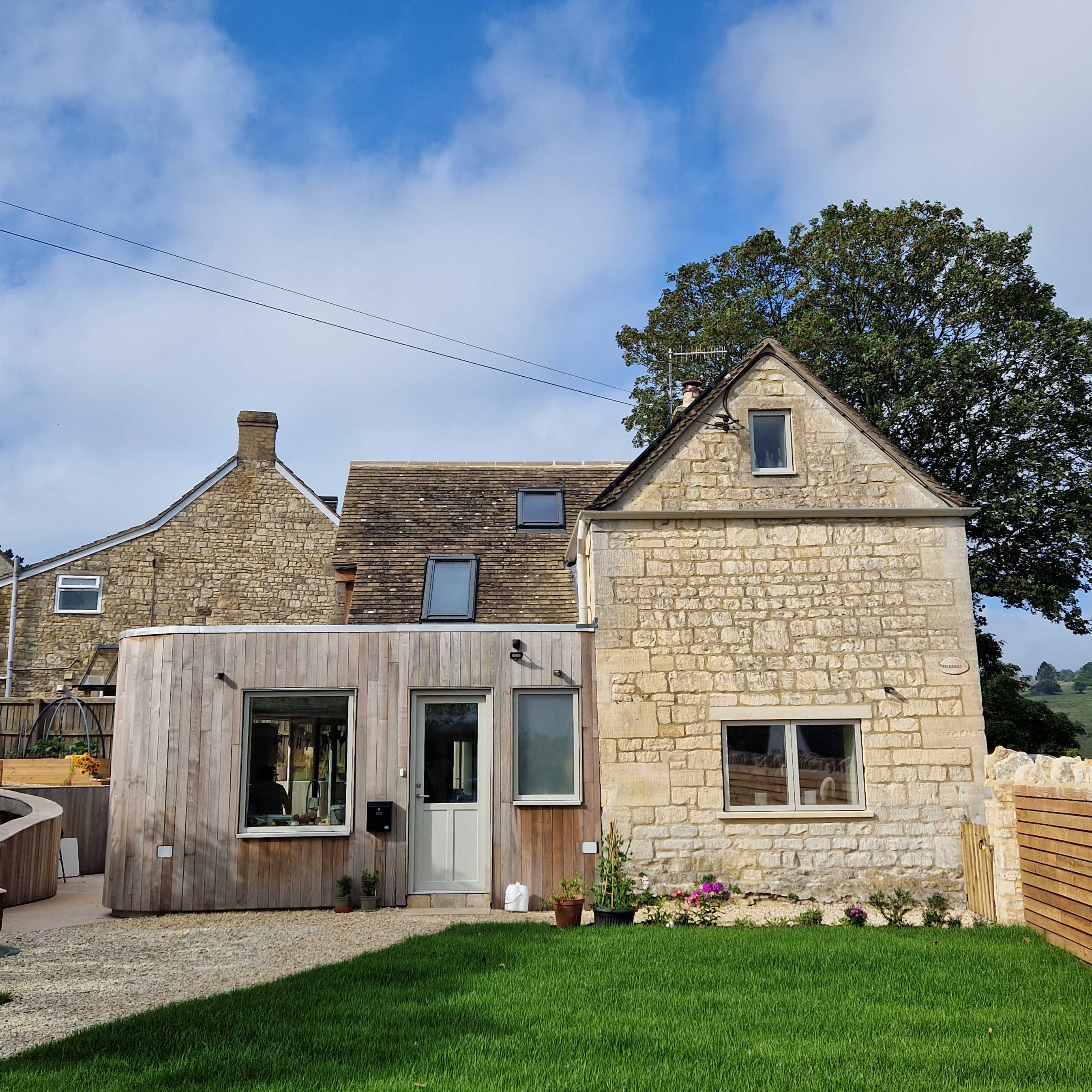
A project built in the 1930’s was transformed into a future proof family home, fully insulated on the outside to minimise heat loss. Triple-glazed windows were installed and all elements of the building were carefully detailed to optimise performance. The results of the airtightness test were outstanding, with air changes per hour (ACH) well below the typical retrofit benchmark at 1.71 ACH. This airtightness, combined with MVHR, ensured a steady supply of fresh, filtered air making the internal environment extremely healthy. To further enhance energy efficiency the home was upgraded with an Air Source Heat Pump, replacing the previous heating system with a low-carbon alternative. The project is ahead of the RIBA’s 2030 Climate Pledge targets, and gives us valuable experience which we can now share with others. 70% of projects in 2024 go beyond the RIBA 2030 Pledge target and we are committed to achieving 100% by 2026.
Co-evolving with nature
Practice
1. Does the practice use biophilia within the office or regularly host meetings and retreats in natural settings? For example do you have extensive planting within the office or rely on natural patterns and imagery for stress relief or quiet areas.
Our premises have a multitude of flowering plants both inside and out with a beautiful, secluded space for enjoying a calming break during the working day. We are also located in a rural town, with walks out into countryside within a few hundred metres.
2. Can the practice share examples where it has considered nature in decision making? For example by having a nature proxy to encourage eco-centric decision making, using natural systems as inspiration for the company structure, recognising the seasonal nature of people’s capacity and workload or celebrating equinoxes and solstices together.
No.
3. Is the practice supporting nature locally and nationally? For example, does the practice support local gardens, gardeners, planting programmes, rewilding programmes or advocate for changes in legislation to protect nature.
During 2025 we have secured tree canopy cover for the future with new tree planting in the centre of Nailsworth, providing the structural elements to the new Textile Heritage Planting Scheme, a design that includes many dye plants. The proposal re-connects people with the river in the centre of town and the industrial mills it powered. Helping to enable this community scheme bring the past to the present will become part of our legacy and a reminder of our connection to the town.
Project
1. Can the practice demonstrate projects which strive to match the performance of a mature ecosystem? As a minimum this would mean achieving biodiversity net gain.
The natural environment is incredibly important to us and when planning a project we always seek to protect and enrich the natural landscape. Our outdoor spaces are designed to become rich habitats for bees, butterflies and birds and we collaborate with ecologists to create ideal habitats for wildlife to thrive. When providing a master-planning application for the development of 28 homes in 2024 we were able to achieve a massive +17.37% increase in biodiversity net gain. The brief for the project was providing space for nature and people; providing clean air and mitigating flood events, allowing people to engage with nature through play, exercise and community activities, and in turn benefitting people through better physical and mental health. The ambition of the proposal provides young people with skills in land management, as well as getting the community engaged in their neighbourhood via the creation of a heritage orchard and providing space for village events.
2. Is the practice working on material stewardship? For example, evidence could be shown through repeated use of low carbon materials, extensive material libraries and research or publications supporting responsible use of materials and elimination of waste.
We calculate energy use on all of our building projects, whether they are extensions, renovations or new build. We use Passivhaus PHribbon to assess whole life carbon and embodied carbon emissions in buildings
By making informed environmental design decisions, it enables more and more of our projects to align with evolving sustainability regulations such as the RIBA 2030 Climate Challenge and UKGBC net-zero targets. When designing homes, PHribbon is particularly useful as it provides us, with clear and quantifiable insights into the carbon footprint of our projects, ensuring that early-stage decisions contribute to long-term sustainability goals. By integrating carbon analysis with Passivhaus energy modelling, it enables a holistic approach where energy efficiency and carbon reduction go hand in hand. This means that when specifying materials, insulation, or construction techniques, we can evaluate not just their impact on thermal performance but also their contribution to overall emissions, creating healthy buildings for the future.
3. Do the majority of projects demonstrate the use of biologically-inspired approaches such as Bioregionalism, Biophilia, Biomimicry, Ecomimicry (also referred to as Ecosystems Thinking, Industrial Ecology or Industrial Symbiosis) or BioTRIZ?
No.
Creating a just space for people
Practice
1. Does the practice have a progressive EDI policy and can you evidence many forms of diversity, which are welcomed and acknowledged, within the practice?
We have a written EDI policy which is shared with our team.
2. Does the practice operate a no overtime culture, meet the living wage consistently, and stipulate a fair salary ratio between staff of all levels?
Our colleagues are encouraged to fulfil their specified tasks within normal working hours, however, due to deadlines this is not always possible and if work is completed outside of normal hours then time off in lieu is always recognised and insisted upon by senior management.
3. Does the practice support charities, community groups, social enterprises, action groups and others through pro-bono work, charitable giving or in-kind donations?
We made the decision that the best way to serve our community in a meaningful way in 2024-2025, was by partnering with two non-profit organisations that resonate with us; A City Farm in Gloucester and our local Nailsworth Town Council. Both organisations have been able to make use of our skills and expertise in both landscape design, architecture and planning to move their projects forward. We also support the local climate change initiative in Nailsworth.
4. Does the practice publicly refuse to work with certain clients, suppliers or organisations on ethical grounds?
No.
Project
1. Do the projects demonstrate deep engagement with local stakeholders and end users? For example, is there evidence that your project engagement goes beyond consultation towards co-design?
An example, we co-designed a local playground with parents and children through on-site workshops and social-media consultation; similarly, developing a masterplan for green space in our local town for the Town Council. When working on community projects this typically involves community consultation. Much of our work is for private homeowners, which is inherently co-designed and very collaborative as these are personal, bespoke projects for our clients.
2. Do your projects create connected and resilient places which positively contribute to their neighbourhoods and allow equality of access? For example, do your projects create economic opportunity, retain value locally and generate social value?
Working closely with communities and delivering good design, the economic benefits of many projects have extended beyond our clients’ original scope. For example, Horsley Playground has supported the village shop, and the Museum in the Park’s walled garden has become a multi-use space, generating many income streams for the organisation. Our long standing relationship with Ruskin Mill College has enabled us to create space for adults with special needs, providing them with facilities that offer them independence, and a safe environment for learning and creativity in beautiful surroundings.
3. Do the majority of your projects promote equity in society, and consider all people, not only the building inhabitants? For example, do your projects show due regard for workers within the supply chain and take active steps to avoid modern slavery?
Austin Design Works Ltd has a zero-tolerance approach to modern slavery, and we are committed to acting ethically and with integrity in all our business dealings and relationships and to implementing and enforcing effective systems and controls to ensure modern slavery is not taking place anywhere in our own business or in any of our supply chains. We are also committed to ensuring there is transparency in our own business and in our approach to tackling modern slavery throughout our supply chains, consistent with our disclosure obligations under the Modern Slavery Act 2015. This policy applies to all persons working for us or on our behalf in any capacity, including employees at all levels, directors, officers, agency workers, seconded workers, volunteers, interns, agents, contractors, external consultants, third-party representatives, and business partners.