
Submission by Alma-nac.
Being a good ancestor
Practice
1. Does the practice have a clearly stated purpose aligned with the planetary emergency? We are looking for a bold ambition here, and a practice culture which recognises the need for long-term thinking. For example, a strong mission, a theory of change, or a sustainability roadmap.
Alma-nac is a certified B Corp, embedding social and environmental responsibility into its core operations including amending our articles of association to legally bind the company to consider interests of all stakeholders, including employees, suppliers, society, and the environment, not just shareholders. Aligning with this we strongly believe that we must measure our performance and be rigorous with how we do this. We report on this yearly and set new-targets and KPI’s to track our progress and allow us to evolve with new evidence and ideas. We strongly believe our role goes far beyond designing buildings and our privilege of education and knowledge give us a responsibility to collaborate and educate. We continue to develop areas of the practice which require zero embodied carbon but help reduce environmental damage including behaviour change programmes and education workshops.
2. Does the practice have a clear succession plan, which passes on ownership and protects the values and legacy of those who built and contributed to the practice? For example is the practice an employee owned trust.
No.
3. Does the practice share research and knowledge for the benefit of society and the wider world? For example, you regularly carry out post occupancy evaluation and share information with others.
Alma-nac actively contributes to societal and environmental betterment through knowledge sharing and collaborative initiatives. For example as part of the Department for Education’s Net Zero Accelerator Pathfinder for Schools, we have engaged with 25 schools, delivering educational workshops and providing continuous support to help them reduce energy consumption through behavioural changes and practical interventions. We have collected data to show how this works and how much we can reduce carbon emission just through changes in habit. We are now in the process of sharing this data, the first of it’s kind, which will help other institutions implement behaviour change programmes.
During covid we self-published a free guide to adapting schools during covid restrictions. We collaborated with a groups of schools to produce the document and it was downloaded over 5000 times in over 20 countries.
With our building projects we encourage RIBA stage 7 and where that is not possible we utilise the defects liability period to collect data and share this with the client’s consent.
Project
1. Does the practice advocate for long-term thinking at the outset of projects? Do you initiate projects with long-term thinking and challenge the client on design life? Also, can the practice demonstrate that this approach has worked with a shorter or longer design life, or an innovative approach to financing or payback period?
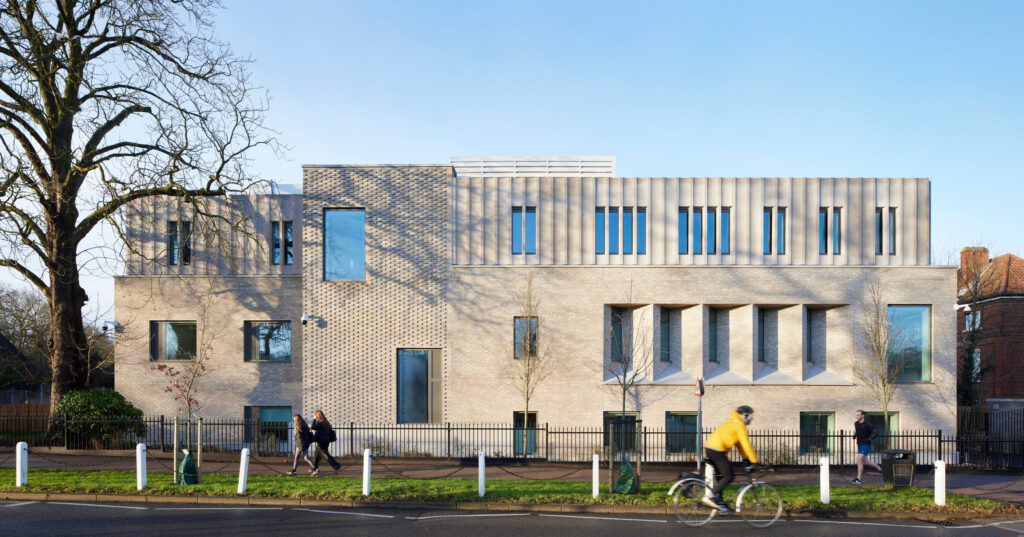
Alma-nac’s approach to the Dulwich College Junior and Lower School project exemplifies our commitment to long-term thinking from the project’s inception. We carried out extensive consolation with all stakeholders including students, teachers and the local community to create a long-term vision for this multi-phased project. The result was a mutli-layered brief which thought deeply about the role of the school in the community and emphasised the importance of creating a building that led the way in terms of sustainability – Whole- life net zero carbon. This brief and the specific NZC target informed every aspect of the design process, from material selection to energy modelling, ensuring the building’s longevity and adaptability. The project integrates the refurbishment of existing structures with new construction, creating a cohesive educational environment that emphasises sustainability and resilience. The design process was informed by, but also developed the longer term thinking for the institution showing how projects can help thinking well-beyond the limits of the physical fabric.
2. Do your projects take account of the future climate and the need for resilience? For example, do the projects demonstrate flexibility, design for adaptation, design for disassembly, non-deterministic solutions, or demountable structures.
Alma-nac’s work at Dulwich College takes clear account of future climate conditions and the need for long-term resilience. From the outset, the project was developed to align with Net Zero Carbon principles in both construction and operation, using LETI targets and energy modelling to guide decisions on materials, form, and building fabric.
The scheme combines sensitive refurbishment of retained structures with a new library building designed for long design life, future adaptability, and robust thermal performance. The structure was coordinated with services to allow future changes in use without invasive interventions. Materials were specified with durability and embodied carbon in mind, and the roof design supports future installation of solar PVs.
Through thoughtful orientation, passive ventilation, shading, and external circulation strategies, the building is designed to remain comfortable in hotter, more volatile future climates. Flexible learning spaces and the use of robust, demountable detailing further future-proof the design.
3. Do the majority of your projects go beyond mitigating negatives and towards optimising positives? For example, are they meeting or exceeding the RIBA 2030 Challenge.
Alma-nac’s projects consistently aim to go beyond reducing harm, instead focusing on delivering long-term social and environmental value. Our design for the new Junior and Lower School at Dulwich College exemplifies this ethos.
The building was designed to meet LETI 2020 and RIBA 2030 Challenge targets, incorporating ultra-low operational energy use, robust thermal performance, and a fabric-first approach.
Rather than simply offsetting impact, the project optimises positives through careful material selection, external circulation strategies, and maximised biodiversity and amenity provision.
This approach is embedded across our portfolio, including work under the DfE Net Zero Pathfinder programme, where we support schools across the UK in understanding and reducing their energy use. We have two housing projects (23 homes in total) set to be passive house standard and we set all our projects to be exemplars in their field including environmental standards
Co-evolving with nature
Practice
1. Does the practice use biophilia within the office or regularly host meetings and retreats in natural settings? For example do you have extensive planting within the office or rely on natural patterns and imagery for stress relief or quiet areas.
Our office is full of plants and we try to get out of the office to see the river (just round the corner) or to a park as often as we can . We measure our internal environment CO2 levels, temperature, light levels and adapt as best we can. We are lucky to have a loft space with great natural light, views and cross ventilation.
2. Can the practice share examples where it has considered nature in decision making? For example by having a nature proxy to encourage eco-centric decision making, using natural systems as inspiration for the company structure, recognising the seasonal nature of people’s capacity and workload or celebrating equinoxes and solstices together.
Where projects allow, we embed nature-first thinking through early ecological assessments, and we prioritise retention of existing habitats and biodiversity net gain. Our approach often uses natural systems and access to external space as design drivers.
While we don’t yet have a formal nature proxy, we hold design reviews that include environmental impact assessments at key stages, ensuring that ecological thinking remains present throughout the process. We are currently exploring ways to bring more cyclical and seasonal rituals into our studio practice.
3. Is the practice supporting nature locally and nationally? For example, does the practice support local gardens, gardeners, planting programmes, rewilding programmes or advocate for changes in legislation to protect nature.
Alma-nac supports nature both locally and nationally through design advocacy and direct engagement. We prioritise ecological enhancement across our projects, working with landscape designers and ecologists to deliver biodiversity net gain through native planting, habitat creation, and sustainable drainage strategies.
Locally, we led a community reuse initiative following the Dulwich Picture Gallery’s Colour Palace Pavilion, developing a safe method for children to repurpose the structure’s timber. This resulted in 150 vibrant modular planters and structures built by pupils across Southwark and Lambeth, fostering engagement with reuse, planting, and outdoor learning. This project took on a life of its own and you can now see bits of the pavilion in a myriad of structures across Southwark.
Project
1. Can the practice demonstrate projects which strive to match the performance of a mature ecosystem? As a minimum this would mean achieving biodiversity net gain.
Alma-nac strives to design projects that actively regenerate their sites and ecosystems. As a baseline, we commit to achieving biodiversity net gain across all projects where applicable, working closely with ecologists and landscape designers from the earliest stages.
Our Dulwich College Junior and Lower School project integrates nature into the heart of the scheme, with new outdoor learning environments, tree retention, and planting strategies that increase ecological value and create new habitats. The design also incorporates green roofs and low-level lighting to support nocturnal species.
At the Thornbrook House site, a new-build terrace is planned alongside an 8-metre wildlife corridor adjacent to the River Wey, which will be retained and enhanced with native planting, bird and bat boxes, and naturalistic landscaping to support pollinators and riverine ecosystems.
Through these approaches, we aim not just to mitigate impact but to create conditions for nature to thrive.
2. Is the practice working on material stewardship? For example, evidence could be shown through repeated use of low carbon materials, extensive material libraries and research or publications supporting responsible use of materials and elimination of waste.
Material stewardship is embedded in alma-nac’s design process. We consistently prioritise low-carbon materials such as timber, recycled content products, and non-toxic finishes, and regularly benchmark against LETI and RIBA 2030 targets. Our internal material library is curated with a focus on lifecycle impacts, provenance, and durability, and is updated through CPDs and collaboration with suppliers committed to sustainable sourcing.
Across our projects – including the net-zero carbon Dulwich College Lower School – material selection is carefully coordinated to minimise embodied carbon, support longevity, and reduce waste during construction. Where possible, we incorporate DfMA (Design for Manufacture and Assembly) and design for disassembly principles.
3. Do the majority of projects demonstrate the use of biologically-inspired approaches such as Bioregionalism, Biophilia, Biomimicry, Ecomimicry (also referred to as Ecosystems Thinking, Industrial Ecology or Industrial Symbiosis) or BioTRIZ?
While not always framed explicitly through terminology like Biomimicry or BioTRIZ, alma-nac’s design approach is strongly aligned with biologically-inspired thinking. Many of our projects adopt biophilic principles, integrating nature into everyday experiences.
Many of alma-nac’s projects demonstrate biologically-inspired design principles, particularly biophilia and ecosystem thinking. A recent deep retrofit of a former mental health clinic into a specialist SEMH school illustrates this approach. The design focused on fostering calm, restorative environments through biophilic strategies: enhanced daylighting, natural finishes, and strong visual and physical connections to nature. Quiet breakout spaces, a muted colour palette, and acoustic interventions support sensory regulation and wellbeing. Externally, a proposed wildflower garden creates biodiverse, therapeutic outdoor space that mirrors internal zones of calm, reinforcing a holistic ecosystem approach. Material choices prioritised local, durable, and natural products, integrating sustainability and place-based thinking into the design.
Creating a just space for people
Practice
1. Does the practice have a progressive EDI policy and can you evidence many forms of diversity, which are welcomed and acknowledged, within the practice?
Alma-nac has a progressive Equality, Diversity and Inclusion (EDI) policy that actively informs recruitment, studio culture, and project work. We are committed to creating a workplace that welcomes and values diversity in all forms – including gender, race, socio-economic background, age, neurodiversity, and lived experience.
Our team reflects a wide range of backgrounds and perspectives, and we recognise this diversity as a strength that enriches our creative process. We support flexible working arrangements, promote inclusive leadership, and regularly review our practices to ensure barriers to access or progression are identified and addressed.
We continue to evolve our policy through lived experience and staff input. EDI is not treated as a standalone goal, but embedded in our everyday practice and professional ethos.
2. Does the practice operate a no overtime culture, meet the living wage consistently, and stipulate a fair salary ratio between staff of all levels?
Alma-nac is committed to fair and ethical working practices across all aspects of the studio. We operate a no-overtime culture and flexi-time encouraging sustainable working hours that respect work-life balance and foster long-term wellbeing. The practice is a London Living Wage employer and reviews salaries annually to ensure all staff are paid equitably and competitively within the industry. We are mindful of salary ratios between junior and senior roles, and work to maintain transparency and fairness in pay progression.
Our workplace culture is built around mutual respect, professional development, and shared ownership of ideas – reflecting our belief that fair employment practices are essential to a resilient, creative, and inclusive practice. ‘Nurturing’ is one of our 5 core values and reflects our commiment to helping each other grow in a supportive environment
3. Does the practice support charities, community groups, social enterprises, action groups and others through pro-bono work, charitable giving or in-kind donations?
Alma-nac actively supports charities, community groups, and social enterprises through our Design for All programme which we launched in 2023 and is now in its 3rd iteration. Set up to offer pro-bono support, the initiative provides built environment expertise to 2–4 small charities and community organisations each year, helping them get early-stage building projects off the ground. The team is made up of Alma-nac (architects), NTA (Planning Consultant), Simple Works (Structural Engineers), OR (M&E) and Stockdale (QS).
The early stage of projects is often the hardest to secure funding for, and our team offers strategic design input, feasibility advice, and engagement support to ensure that socially valuable projects have the strongest possible foundation. The programme is open to England-based charities and community groups with an annual turnover under £1 million.
Through this initiative, alma-nac champions equitable access to good design and ensures that community-focused projects benefit from the same level of care, creativity, and technical rigour as commercial work. It reflects our commitment to social value and our belief in the power of architecture to strengthen local communities.
4. Does the practice publicly refuse to work with certain clients, suppliers or organisations on ethical grounds?
The practice assesses all projects and collaborators on a case-by-case basis and seeks to work with those who share our commitment to sustainability, inclusivity, and social responsibility. Where we feel it is appropriate to publicly refuse work we do but we also try to consider the course of action that is most likely to have a positive impact. Sometimes that does need to be public.
Project
1. Do the projects demonstrate deep engagement with local stakeholders and end users? For example, is there evidence that your project engagement goes beyond consultation towards co-design?
Our work with L8 Matters CLT to provide community led passive homes in one of the most deprived areas in Liverpool illustrates are values and belief in the importance co-design. Through a series of person workshops we have developed the ambition and brief by listening to stories of the past and imagining the future together. Through making models together and studying precedents we’ve come up with House types to suit the community and a communal garden that embodies the values and spirit of L8.
Dulwich College Junior and Lower School project also exemplifies our approach to meaningful engagement that goes beyond consultation towards co-design where we ran similar design workshops with students begging by being architects in residence at the school for 3 months. Our work with the DFE where we have ran 25 school workshops empowering students to reduce their own emissions through developing their own programme of behaviour change exemplifies our focus on providing agency and knowledge to all building users.
2. Do your projects create connected and resilient places which positively contribute to their neighbourhoods and allow equality of access? For example, do your projects create economic opportunity, retain value locally and generate social value?
Alma-nac’s Tooting Works project exemplifies our commitment to creating connected and resilient places that deliver lasting social value and ensure equal access. Designed for local charity Business Launchpad, the project transformed a neglected office block into a vibrant community and co-working hub. Despite a modest budget, the design unlocked new opportunities for over 300 daily users, supporting youth enterprise, community events, and affordable workspace.
The project integrates teaching kitchens, flexible spaces, and co-working areas that are accessible and adaptable. Revenue is reinvested into outreach and support programmes, helping to retain value locally and nurture grassroots enterprise.
The bold, highly visible refurbishment has re-established the building as a local landmark, welcoming diverse users and reinforcing identity and civic pride. By working closely with BLP over six years, alma-nac co-developed a vision rooted in community needs, economic resilience, and spatial inclusion – delivering architecture that uplifts and empowers its neighbourhood.
3. Do the majority of your projects promote equity in society, and consider all people, not only the building inhabitants? For example, do your projects show due regard for workers within the supply chain and take active steps to avoid modern slavery?
Alma-nac designs with the belief that architecture should promote equity not only for building users but also for the wider community and those involved in bringing projects to life. We embed inclusive access, social value, and community benefit into our design process, ensuring projects serve broader societal goals.
We also take seriously the responsibility to uphold fairness within our supply chains. As part of our procurement approach, we work with contractors who demonstrate compliance with ethical labour practices and take steps to avoid modern slavery. Where possible, we specify suppliers who align with these principles and prioritise transparency and traceability.
Our “Design for All” initiative further reflects our belief that good design should be accessible to all communities – not just those who can afford it. Through this programme and our wider portfolio, we aim to design for equity at every scale.