
Submission by Allford Hall Monaghan Morris.
Being a good ancestor
Practice
1. Does the practice have a clearly stated purpose aligned with the planetary emergency? We are looking for a bold ambition here, and a practice culture which recognises the need for long-term thinking. For example, a strong mission, a theory of change, or a sustainability roadmap.
AHMM has published its environmental policy on its website, outlining our approach to environmental impacts. Alongside this. AHMM’s annual carbon emissions report is published, as part of its commitment to the Science Based Targets initiative (SBTi).
The Report includes an overview of the company’s Scope 1, 2, and 3 operational emissions for 2023, as well as the upfront carbon emissions of its architectural projects that achieved practical completion in 2023. These figures are reported in comparison to the baseline year of 2022.. In recognition of the difference in scale of carbon emissions between projects and company operations, the report reviews the two measurements and their contributing factors separately.
The report shows that from 2022 to 2023 the company’s total operational emissions have reduced from 1406 tCO2e to 1006 tCO2e, with the 2023 figure being 323 tCO2e below target based on AHMM’s net zero trajectory plan.
2. Does the practice have a clear succession plan, which passes on ownership and protects the values and legacy of those who built and contributed to the practice? For example is the practice an employee owned trust.
In 2017 the majority shareholding of AHMM Limited transferred to an Employee Ownership Trust. This means that the practice’s employees are majority owners of the company and are represented on the Trust’s board by two elected Employee Directors, alongside two founding directors of AHMM and an independent director and chair of the board. The current Trustees are Peter Morris, Jonathan Hall, Sam Scott, James Ellender and Graeme Nuttall (independent Chair). The Trustees are, in turn, supported by an EOT Working Group made up of staff from across the practice. Becoming employee-owned has formalised our long-held belief that the success of the company and its work comes from having a positively engaged team, where each person is invested in where they work and what they do. The company’s main Board is currently made up of the Practice Founders, but it will evolve with the introduction of new members in due course.
3. Does the practice share research and knowledge for the benefit of society and the wider world? For example, you regularly carry out post occupancy evaluation and share information with others.
AHMM has been building on our Fit Out / Rip Out research published last year (looking at the wasteful patterns of using commercial tenanted offices) and is working with UCL and a PhD researcher investigating the architectural implications of Smart Buildings. This has resulted in two academic publications so far, which we are working up for general publication.
The first paper investigated the Impact of Dynamic Envelope Control Strategies on a Building’s Performance. AHMM hope that this work will lead to a sensible and intelligent use of smart technologies in buildings to optimise performance.
Sharing the outcomes of this work, we hope, will provide insights for others to build on.
Project
1. Does the practice advocate for long-term thinking at the outset of projects? Do you initiate projects with long-term thinking and challenge the client on design life? Also, can the practice demonstrate that this approach has worked with a shorter or longer design life, or an innovative approach to financing or payback period?
The design of Arthur Stanley House celebrates the original 1960’s building alongside its 21st century additions and complements the conservation area which in parts is fragmented with post-war and recent large-scale developments interspersed with lower scale, historic terraces. The refurbished building reconnects it to the townscape with a low energy building which puts is occupants’ wellbeing at its heart with external terraces, a heat recovery system and enhanced cycling facilities, making this a dynamic, forward looking new space for working and living. New and old is left exposed within the floorplates to represent the building’s development over a 60-year period, repurposing it for a new generation by creating a design led space for the next 60 years and more. The Cat A fitout in the building was designed to allow for easy reconfiguration, and incoming tenants have been able to adapt the spaces for their own purposes.
2. Do your projects take account of the future climate and the need for resilience? For example, do the projects demonstrate flexibility, design for adaptation, design for disassembly, non-deterministic solutions, or demountable structures.
Google commissioned AHMM to develop a modular unit which would have the full functionality of a meeting room yet could be built or taken down and reassembled elsewhere in a matter of hours or days. The idea was to have a meeting room that would be deliverable within a similar timeframe to the constantly evolving and changing business processes and team structures.
The result, known as Jack, is a bespoke, modular room and spatial accessory system built from timber cassettes that can be assembled, reassembled and reconfigured in a variety of ways to create differently sized, fully or partially enclosed spaces. A total of 160 Jack meeting rooms were installed in Google’s London HQ with prototypes being sent to other international Google offices, including India.
We continue to utilise Jack as a flexible, resilient piece of office infrastructure in all sorts of projects.
3. Do the majority of your projects go beyond mitigating negatives and towards optimising positives? For example, are they meeting or exceeding the RIBA 2030 Challenge.
We measure our projects against benchmarks – the Net Zero Carbon Building Standard most recently – using our bespoke Zero Carbon Toolkit. While we strive to go beyond mitigating negatives towards optimising positives but it is not always possible. However, because we measure all of our projects, where we don’t achieve our ambitions we know why. We are able to learn lessons and apply better strategies next time.
Co-evolving with nature
Practice
1. Does the practice use biophilia within the office or regularly host meetings and retreats in natural settings? For example do you have extensive planting within the office or rely on natural patterns and imagery for stress relief or quiet areas.
We continue to use Plantcare for our in house biophilia in our Bristol office. Both UK offices have hosted ‘Tree Walk’ events in the last year and all staff are encouraged to take part in volunteering activities which include activities to reconnect with nature through tree planting, maintenance and working with animals.
All offices have a quiet room where staff can retreat for focused work or a break from their workspaces.
2. Can the practice share examples where it has considered nature in decision making? For example by having a nature proxy to encourage eco-centric decision making, using natural systems as inspiration for the company structure, recognising the seasonal nature of people’s capacity and workload or celebrating equinoxes and solstices together.
No.
3. Is the practice supporting nature locally and nationally? For example, does the practice support local gardens, gardeners, planting programmes, rewilding programmes or advocate for changes in legislation to protect nature.
As part of our Partnerships work, we support smaller nature-focused initiatives where we believe we can have greatest impact through volunteering and donations. In 2024/25 we donated to £6,000+ to ten nature focused charities. Our Bristol Charity of the Year 2025 is Avon Needs Trees and support includes Tree Care volunteering days and a donation of £2,000+.
We also support nature-focused education programmes. Our Bristol office contributed to ‘Climate Change All Change’, a national programme bringing together primary school students and designers to promote greater understanding of ways to protect nature and co-create solutions to the climate crisis. For Open City’s Young City Makers, the AHMM team explored with primary school students ways to protect and celebrate an ancient mulberry tree sited within our London Chest Hospital project. The children used potted herbs within their modelmaking to represent the mulberry tree and we were awarded the 2024 ‘Materials’ category prize.
Project
1. Can the practice demonstrate projects which strive to match the performance of a mature ecosystem? As a minimum this would mean achieving biodiversity net gain.
No.
2. Is the practice working on material stewardship? For example, evidence could be shown through repeated use of low carbon materials, extensive material libraries and research or publications supporting responsible use of materials and elimination of waste.
AHMM’s bespoke materials library is a digitised database cataloguing 11,000+ architectural and interior product samples from our libraries in London and Bristol. Materials are classified by ‘sample properties’ and ‘product family properties’ e.g. colour, dimensions; ‘performance properties’ e.g. fire resistance, thermal, acoustic; and ‘sustainability properties’ e.g. links to EPDs, recycled content, VOCs.
Users can filter by material property/project requirements, and sort results by embodied carbon, using EPD data where available and indicative generic datasets where not. A more holistic ‘Sustainability Assessment System’ is being implemented, scoring library materials across nine weighted criteria – including toxicity, ingredient transparency, renewable content, circularity and lifespan – to allow nuanced comparison of products within and between material typologies, and facilitate project teams in making more informed material choices. A comprehensive usage audit was carried out last year, which is informing the updating and development of the collection, alongside feedback from an internal steering group.
3. Do the majority of projects demonstrate the use of biologically-inspired approaches such as Bioregionalism, Biophilia, Biomimicry, Ecomimicry (also referred to as Ecosystems Thinking, Industrial Ecology or Industrial Symbiosis) or BioTRIZ?
No.
Creating a just space for people
Practice
1. Does the practice have a progressive EDI policy and can you evidence many forms of diversity, which are welcomed and acknowledged, within the practice?
The AHMM Equity, Diversity and Inclusion (ED&I) Working Group is formed of a group of volunteer employees who have been working together since 2020 to identify the challenges and opportunities that exist in relation to ED&I at AHMM. To support the practice, the ED&I Working Group is focused on four pillars: Culture, Resources, Data, and Engagement.
Alongside the ED&I Working Group and Partnerships Group, there are a number of groups of staff that come together to discuss specialist topics such as the Gender Pay Gap, Neurodiversity, and LGBTQIA+.
In 2025 AHMM published a Neurodiversity policy and a Women’s Health policy, which provides specialist guidance to support the existing ED&I policy.
AHMM collects staff ethnicity and gender, which is published in the annual ED&I report. For the 2025 report the practice has expanded its data set to include age and sexual orientation
2. Does the practice operate a no overtime culture, meet the living wage consistently, and stipulate a fair salary ratio between staff of all levels?
AHMM continues to be an equal opportunity employer and meet the London Living Wage across all levels of employment.
We have recently published our Gender Pay Report 2025 which although shows a slight increase for the median figure shows a decrease for the mean figure. We are proud of the progress made under the Action Plan developed in 2018 by our Gender Pay Gap Working Group, but while many of these initiatives have had the positive impacts we had hoped for in supporting women in their careers at AHMM, the fact remains that our Gender Pay Gap is primarily the result of a greater number of the most senior roles still being performed by men, a structural issue that requires more sustained effort to address. AHMM’s focus now is to create a new plan of action, built collaboratively with our employees and informed by their experiences, feedback, and ideas.
3. Does the practice support charities, community groups, social enterprises, action groups and others through pro-bono work, charitable giving or in-kind donations?
AHMM Partnerships supported VCSEs through volunteering and donating to 62 charities in 2024/25. Through our education engagements, we gave 1,431 staff volunteering hours and donated £51,000.
Other charity support includes Street Goat, connecting communities in Bristol to their food and land through goats; Black2Nature – aiming to make nature relatable and equitable; The Bike Project, our London Charity of the Year, providing second hand bikes to refugees, also pro bono services to improve their bike workshop and storage space.
Other charities supported include: St Luke’s Community Centre green skills programme, City to Sea, Avon Wildlife Trust, Windmill Hill City Farm, Abundance London, Sustrans and Architects Declare.
Pro-bono work has increased and includes our Sustainability team preparing planning permission documentation including for heat pumps for Power Up North London, a charity that helps community buildings decarbonise their operations, and designing a second cookery school for refugee charity Migrateful in Bristol.
4. Does the practice publicly refuse to work with certain clients, suppliers or organisations on ethical grounds?
No.
Project
1. Do the projects demonstrate deep engagement with local stakeholders and end users? For example, is there evidence that your project engagement goes beyond consultation towards co-design?
We aim to create innovative, responsive social value that is specific to the communities where our projects are sited.
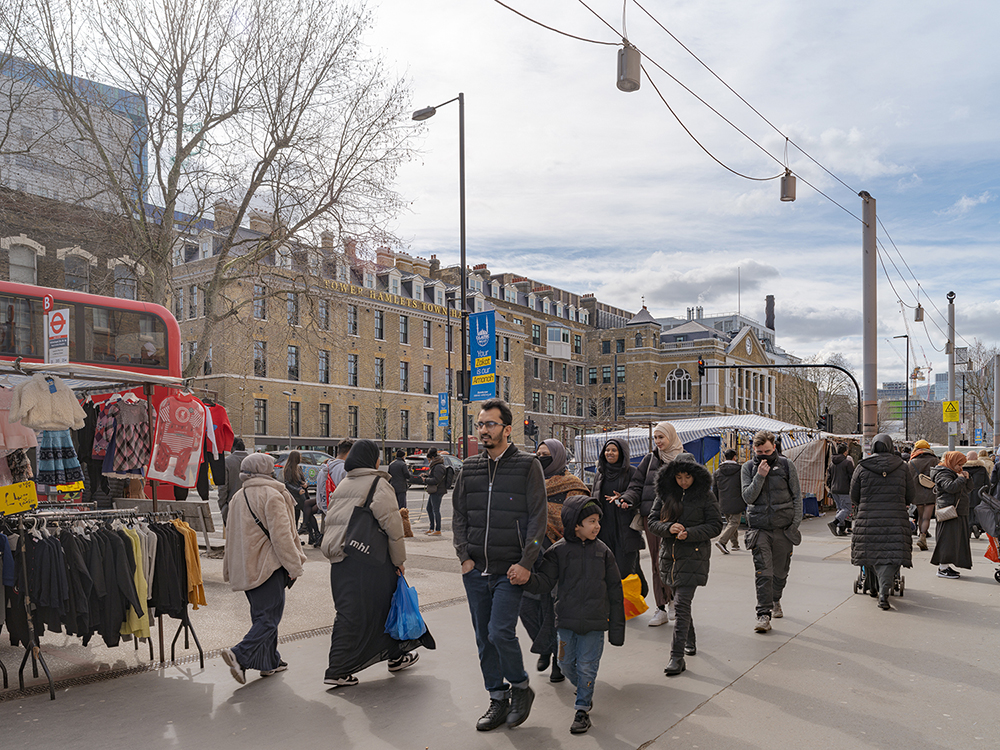
During the design and construction of Tower Hamlets Town Hall the project team engaged extensively with the local community, creating 19 local apprenticeships and engaging with over 400 people. Approximately £6m of goods and services were purchased from local businesses during construction, with a predicted future annual spend from the project estimated at £4.1m within the area.
We developed a social value programme to engage young people with the building and its processes, working with the Design Technology department at Swanlea Secondary School in Whitechapel. Support included careers information, mentoring, work experience, site tours, workshops, portfolio reviews, design challenges, and places at AHMM’s Summer School.
AHMM was awarded a Thornton Education Trust Inspiring Future Generations Award in the Social Value category for our work connected to Tower Hamlets Town Hall.
2. Do your projects create connected and resilient places which positively contribute to their neighbourhoods and allow equality of access? For example, do your projects create economic opportunity, retain value locally and generate social value?
Alongside the work carried out by our Partnership group focusing on social outreach and engagement, we have been developing a toolkit that can be used by our designers to leverage social value through the brief and design development of our Architectural projects.
Below are the key principles that are guiding the development of the tool
- This resource is not intended to be a tool kit for the quantification of ‘value’
- This resource will build a database of case studies, external references and external organisations that can be used to build a bespoke ‘social value’ plan for each project
- The resource should be accessible and easy to use at all stages of a project.
- The tool kit to be a conduit between the practices design work and the Partnership Group
Do the majority of your projects promote equity in society, and consider all people, not only the building inhabitants? For example, do your projects show due regard for workers within the supply chain and take active steps to avoid modern slavery?
AHMM does not tolerate slavery or human trafficking, striving to put in place systems and processes to ensure it does not take place in our work, our operations or our supply chain. This is tracked through a comprehensive questionnaire for our suppliers. Our in-house Legal & Appointments team is responsible for reading, checking contracts, statements, policies and terms and conditions for not only our architectural projects, but all suppliers, contractors and any persons or company providing a service to AHMM.
We expect our suppliers to extend the principle of fair and honest dealings, as we do to them, to all whom they do business, including employees, sub-contractors and other third parties. For example, our contracted cleaning personnel are to be paid the London Living Wage.
As an RIBA Chartered Practice, we maintain high levels of honesty, competency and professionalism and adherence to the RIBA Code of Practice.