
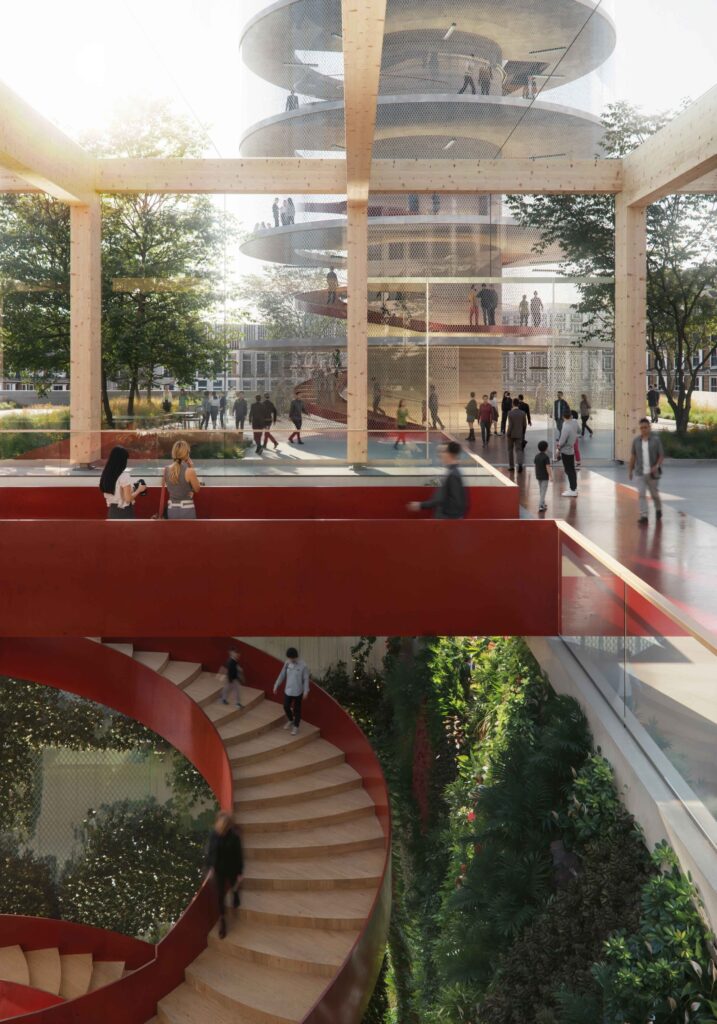
Submission by Able Partners.
Being a good ancestor
Practice
1. Does the practice have a clearly stated purpose aligned with the planetary emergency? We are looking for a bold ambition here, and a practice culture which recognises the need for long-term thinking. For example, a strong mission, a theory of change, or a sustainability roadmap.
Able Partners is committed to designing a built environment that responds to the urgent challenges of the planetary emergency. Our practice is driven by the belief that architecture must actively contribute to environmental regeneration, social equity, and long-term resilience. We recognise that incremental improvements are not enough; transformative change is essential.
Our purpose is to embed sustainability at the core of every project, ensuring that our work not only reduces harm but also creates positive ecological and social impact. We are developing a sustainability roadmap that aligns with circular economy principles, net-zero carbon ambitions, and socially responsible design strategies.
We foster a culture of long-term thinking, balancing technical excellence with a deep commitment to co-creation and community engagement. By leveraging design as a tool for systemic change, we aim to shape places that enhance biodiversity, reduce carbon footprints, and support thriving, resilient communities for generations to come.
2. Does the practice have a clear succession plan, which passes on ownership and protects the values and legacy of those who built and contributed to the practice? For example is the practice an employee owned trust.
As a young practice established three years ago, Able Partners is actively shaping a long-term vision for ownership, succession, and legacy. While we are not yet an employee-owned trust, we are committed to fostering a collaborative and inclusive business model that ensures the practice’s values and purpose endure beyond its founders.
We believe that a strong succession plan is essential to protecting the integrity of our work and the contributions of those who help shape the practice. Our aim is to develop a structure that supports shared leadership, professional growth, and collective responsibility. We are exploring models of governance that will allow us to transition toward a more distributed form of ownership, ensuring that future generations of architects within Able Partners can have a meaningful stake in its direction.
Through mentorship, knowledge-sharing, and a culture of transparency, we are building a resilient foundation for long-term success and continuity.
3. Does the practice share research and knowledge for the benefit of society and the wider world? For example, you regularly carry out post occupancy evaluation and share information with others.
Able Partners is committed to sharing research and knowledge to drive positive change within the built environment. We believe architecture should contribute to broader societal learning, and we actively seek ways to evaluate and disseminate insights from our work.
Although we are a young practice, we are developing a structured approach to post-occupancy evaluation (POE) to ensure our projects meet long-term sustainability, well-being, and performance goals. We aim to embed a culture of continuous learning, using feedback from completed projects to inform future designs and share best practices with the broader industry.
David brings valuable experience to this area, having implemented independent POEs on several completed projects in his previous practice. His expertise in evaluating building performance and user experience strengthens our commitment to knowledge-sharing. We seek to collaborate with clients, end-users, and fellow practitioners to ensure that our lessons contribute to a more resilient and responsible built environment.
Projects
1. Does the practice advocate for long-term thinking at the outset of projects? Do you initiate projects with long-term thinking and challenge the client on design life? Also, can the practice demonstrate that this approach has worked – with a shorter or longer design life, or an innovative approach to financing or payback period?
Long-term thinking is central to our approach, and we challenge clients early on to consider design life, future adaptability, and whole-life value. At the Gateway Building for the University of Nottingham’s Sutton Bonington campus, David Patterson led the winning design while at a previous practice, advocating for a future-proofed, low-carbon solution. The building was constructed using locally sourced straw grown on site, showcasing an innovative approach to material sourcing, carbon reduction, and circular design. Its modular structure and passive design strategies support long-term adaptability and low operational costs. Close collaboration with the university ensured alignment between sustainability goals and financial planning, delivering strong lifetime value and resilience. Over a decade later, the building continues to perform efficiently, exemplifying how early long-term thinking can reduce environmental impact, enhance flexibility, and extend a project’s value far beyond initial capital expenditure. This ethos underpins our work at Able Partners today.
2. Do your projects take account of the future climate and the need for resilience? For example, do the projects demonstrate flexibility, design for adaptation, design for disassembly, non-deterministic solutions, or demountable structures.
We actively consider future climate challenges and embed resilience from the outset. David Patterson’s experience leading the design of the Monica Partridge Building at the University of Nottingham exemplifies this approach. The building was conceived as a long-life, loose-fit structure–prioritising flexibility and future adaptation to support evolving teaching and learning models. A simple, rational floorplate and clear structural strategy allow for internal reconfiguration without major structural intervention, enabling the building to respond to changing pedagogical needs over time. The passive design approach–including natural ventilation, thermal mass, and solar control–was carefully calibrated to mitigate future climate impacts and reduce operational energy use. The building’s materials and detailing were selected with durability and maintenance in mind, and the design avoids unnecessary complexity, enabling efficient use, management, and potential future disassembly. This ethos of adaptability, resilience, and environmental sensitivity continues to inform our work at Able Partners today.
3. Do the majority of your projects go beyond mitigating negatives and towards optimising positives? For example, are they meeting or exceeding the RIBA 2030 Challenge.
Our projects aim beyond simply mitigating negative impacts. They seek to actively optimise environmental and social positives. We design with whole-life carbon, wellbeing, and long-term community value, aligning with the RIBA 2030 Climate Challenge where possible. David Patterson’s experience leading the design of The Barn and the Monica Partridge Building at the University of Nottingham demonstrates this ethos. Both projects won RIBA Sustainable Architecture Awards, recognising their innovative integration of passive design, flexibility, and low-carbon strategies. The Barn, built using locally grown straw, and the Monica Partridge Building, designed with natural ventilation and long-term adaptability, exemplify how architectural design can contribute positively to the environment and society. These buildings perform exceptionally and support sustainable learning environments and community engagement. At Able Partners, we are committed to continuing this approach–designing for performance, resilience, and social value to help clients exceed today’s sustainability standards.
Co-evolving with nature
Practice
1. Does the practice use biophilia within the office or regularly host meetings and retreats in natural settings? For example do you have extensive planting within the office or rely on natural patterns and imagery for stress relief or quiet areas.
Able Partners are based at The Society Building in Fitzrovia, a workspace that supports wellbeing through extensive planting, natural light, and various spaces for quiet work and collaboration. The practice explores how nature can be more intentionally integrated into its working and design approach. This includes a current adaptive re-use project at Old Steine in Brighton, where natural materials, patterns, and views are considered to support user wellbeing. David brings experience from previous projects such as Bushfield Camp in Winchester, a masterplan for a new sustainable community on a former military site. The project involved extensive on-site engagement with local communities and stakeholders, including the South Downs National Park, often in outdoor settings. These experiences reinforced David’s belief in the value of natural environments for open, reflective conversation, an approach he is helping to embed at Able Partners in our design work and practice culture.
2. Can the practice share examples where it has considered nature in decision making? For example by having a nature proxy to encourage eco-centric decision making, using natural systems as inspiration for the company structure, recognising the seasonal nature of people’s capacity and workload or celebrating equinoxes and solstices together.
At Able Partners, we strive to embed nature into our decision-making processes through various practical approaches. We consider natural systems as key inspirations for our design work and have begun to explore how these can influence our company culture, fostering creativity, sustainability, and well-being. While we are in the early stages of formalising eco-centric decision-making, we aim to introduce a nature proxy to encourage greater environmental mindfulness in our projects and daily operations. We also recognise the seasonal rhythms that impact our team’s capacity and workload, with plans to build flexibility into our working structure. Although we have not yet formalised celebrating equinoxes and solstices, we are keen to incorporate these milestones as part of our ongoing commitment to work-life balance and to celebrate our connection to the natural world. Our ambition is to evolve these practices as we grow continuously.
3. Is the practice supporting nature locally and nationally? For example, does the practice support local gardens, gardeners, planting programmes, rewilding programmes or advocate for changes in legislation to protect nature.
We are committed to embedding sustainability and social value into the projects we deliver. As a young and growing practice, we actively seek ways to integrate nature-positive approaches into our work and culture
In our projects, we champion green infrastructure, biodiversity net gain, and sensitive landscape design, advocating for the role of nature in supporting health, wellbeing, and placemaking. We work collaboratively with clients and consultants to promote sustainable planting, biodiverse environments, and the enhancement of outdoor spaces as part of our design process.
We are inspired by urban rewilding, temporary greening of vacant sites, and community-led growing projects. Our team brings experience in landscape-led regeneration and green social infrastructure, and we are committed to incorporating this ethos into our work
As we grow, we are exploring partnerships with local organisations focused on nature-based initiatives. We aim to formalise these relationships and expand our impact in the years ahead.
Projects
1. Can the practice demonstrate projects which strive to match the performance of a mature ecosystem? As a minimum this would mean achieving biodiversity net gain.
We place biodiversity and ecological performance at the heart of the design process, recognising the benchmark set by the richness and balance of mature ecosystems.
Although a young practice, our leadership brings proven experience in delivering projects where biodiversity net gain is central. David Patterson, now leading design at Able Partners, led the Bushfield Camp Masterplan at a previous practice, an ambitious scheme on ecologically rich chalk grassland outside Winchester. The masterplan achieved over 10% biodiversity net gain, a significant result on such a sensitive site, through habitat creation, enhancement of existing grasslands and the introduction of connected green corridors to support wildlife.
This level of ambition shapes our approach today. We collaborate with ecologists, landscape designers, and clients to ensure that environmental performance is a fundamental design driver in the projects we deliver.
2. Is the practice working on material stewardship? For example, evidence could be shown through repeated use of low carbon materials, extensive material libraries and research or publications supporting responsible use of materials and elimination of waste.
We are developing a transparent and proactive approach to material stewardship, recognising the importance of responsible specification in reducing embodied carbon, supporting a circular economy and eliminating waste.
We prioritise the use of low-carbon materials, recycled content, and reuse, with material choices considered from the earliest design stages through structured QA and design review processes. Our approach is informed by recognised guidance, including the LETI Embodied Carbon Primer, RIBA Sustainable Outcomes Guide, and emerging best practices in circular construction.
We are in the process of establishing material libraries, research resources and CPD programmes to support informed decision-making across the practice. This is underpinned by leadership experience in delivering projects where material efficiency and environmental performance are key drivers.
Looking ahead, we aim to strengthen this work through collaboration with suppliers, consultants, and material specialists and the development of research and publications to share knowledge and support industry-wide change.
3. Do the majority of projects demonstrate the use of biologically-inspired approaches such as Bioregionalism, Biophilia, Biomimicry, Ecomimicry (also referred to as Ecosystems Thinking, Industrial Ecology or Industrial Symbiosis) or BioTRIZ?
We believe the future of design lies in working with the intelligence of natural systems to create places that are regenerative, resilient, and life-enhancing. While approaches such as Bioregionalism, Biophilia, Biomimicry, Ecomimicry, and BioTRIZ are not yet formally embedded across all our work, these principles are increasingly shaping our thinking and ambition. At Bushfield Camp, we explored how landscape-led regeneration, biodiversity, and ecological memory could underpin meaningful placemaking. At the Sidney Cooper Art Gallery, alongside carefully reusing the historic fabric, we have introduced new landscape spaces that promote biodiversity, soften the urban environment, and connect the building back to its wider ecological setting. As we grow the early-stage design side of our practice, we are committed to deepening our understanding of these methodologies and embedding them more systematically, placing nature-based innovation and systems thinking at the heart of how we design and collaborate.
Creating a just space for people
Practice
1. Does the practice have a progressive EDI policy and can you evidence many forms of diversity, which are welcomed and acknowledged, within the practice?
At Able Partners, we are committed to fostering an inclusive and equitable culture, underpinned by our formal Equality, Diversity, and Inclusion (EDI) Policy. As a young and growing practice, we recognise the value that different backgrounds, identities, and experiences bring to our team and our work. Our leadership includes representation from the LGBTQ+ community, which helps shape an inclusive approach grounded in lived experience. Our EDI policy sets out our commitment to promoting fairness, respect, and equal opportunities, ensuring that all forms of diversity, including race, ethnicity, gender identity, sexuality, socio-economic background, disability, and neurodiversity, are actively welcomed and acknowledged. We embed these principles into our recruitment processes, team culture, and project work, and we are committed to reviewing and improving our practices regularly. Inclusion is not just a policy for us, it is integral to how we work and collaborate.
2. Does the practice operate a no overtime culture, meet the living wage consistently, and stipulate a fair salary ratio between staff of all levels?
We are committed to fair pay and a healthy work-life balance. We consistently meet or exceed the London Living Wage for all employees and do not operate a culture of expected or unpaid overtime. Where additional hours are occasionally needed to meet project deadlines, this is discussed in advance and time off in lieu is offered. As a small and growing practice, we do not currently have a formal salary ratio policy between the highest and lowest-paid staff. However, salaries are set transparently, based on experience, role, and responsibility, with fairness as a key principle. As the practice develops, we are committed to regularly reviewing our pay structures and employment policies to ensure they continue to reflect these values. We aim to create a supportive, respectful working environment where wellbeing, fairness, and opportunity are embedded in the business culture.
3. Does the practice support charities, community groups, social enterprises, action groups and others through pro-bono work, charitable giving or in-kind donations?
We actively support charities, community groups, and social enterprises through pro bono work, mentoring, and volunteering. Our leadership team is involved in several initiatives that reflect our commitment to social impact and inclusion. This includes mentoring young people through the People’s Pavilion and supporting emerging talent as a student mentor. A team member serves as Chair of RIBA West London and sits on the Hackney Design Review Panel, both of which have voluntary roles focused on promoting design quality and community engagement. We also support the Sidney Cooper Research Group, offering expertise to help shape its future as a cultural and community asset. In addition, we contribute time to the London Festival of Architecture Design Panel, providing design advice for community-led projects. These activities reflect our belief in sharing knowledge, broadening access to the profession, and supporting projects that deliver meaningful social value.
4. Does the practice publicly refuse to work with certain clients, suppliers or organisations on ethical grounds?
We do not maintain a public list of excluded clients, suppliers, or organisations. Still, we reserve the right to refuse to work with those whose activities conflict with our ethical commitments. This includes non-compliance with the Modern Slavery Act 2015, breaches of equality and anti-discrimination principles set out in our Equality, Diversity, and Inclusion Policy, or failure to meet environmental standards described in our Environmental Statement. Our Supplier Code of Conduct and contractual obligations make these expectations clear to suppliers and partners. While we do not routinely publicise refusals, we are transparent in upholding these standards and will decline or terminate relationships where these commitments are not met.
Projects
1. Do the projects demonstrate deep engagement with local stakeholders and end users? For example, is there evidence that your project engagement goes beyond consultation towards co-design?
Our projects, including the Sidney Cooper Art Gallery, demonstrate deep engagement with local stakeholders and end users. For this project, we have worked closely with a range of community members, including university stakeholders, gallery curators, and local artists, to ensure the design aligns with the cultural and practical needs of the community. This engagement has gone beyond consultation and has evolved into a co-design process.
We actively involved end users in key design decisions, particularly concerning the gallery’s exhibition spaces and public access areas. This collaborative approach has ensured that the design is functional and reflects the aspirations of those who will interact with the space regularly. Through regular workshops and feedback sessions, we have ensured that the final design will serve as both an exhibition space and a vibrant community hub, fostering an inclusive and engaging cultural environment for all users.
2. Do your projects create connected and resilient places which positively contribute to their neighbourhoods and allow equality of access? For example, do your projects create economic opportunity, retain value locally and generate social value?
We are dedicated to creating connected, resilient places that positively impact their neighbourhoods. Our projects prioritise inclusivity and equality of access. For example, in the Sidney Cooper Gallery, we are designing a cultural venue that will support local economic growth by attracting visitors and fostering creative initiatives. Our focus on accessibility ensures the space is welcoming to all. Experience from urban regeneration projects such as Canterbury’s Tales of England demonstrates the ability to reconnect communities with their heritage, while adding social and economic value. At Able Partners, we aim to create spaces that foster collaboration, retain local value, and offer long-term opportunities for growth. This approach reflects our belief that architecture has the power to drive positive change, creating environments that support both the community and its future development.
3. Do the majority of your projects promote equity in society, and consider all people, not only the building inhabitants? For example, do your projects show due regard for workers within the supply chain and take active steps to avoid modern slavery?
We are committed to promoting equity and fairness in all aspects of our work. We understand the importance of considering the broader impact of our projects, beyond just the building inhabitants. In line with our Modern Slavery Policy, we ensure that our supply chains are ethically managed, focusing on fair labour practices and compliance with the Modern Slavery Act 2015. We work closely with our suppliers to assess and mitigate risks, ensuring transparency and accountability across our business dealings.
All suppliers are required to demonstrate compliance with anti-slavery legislation, and we include anti-slavery clauses in our contracts, making it a condition of business. Through ongoing monitoring and audits, we ensure that human rights are respected throughout our supply chains, with clear reporting mechanisms in place for employees and partners to raise concerns.
We continue to improve our practices, striving to create positive social impact through our design and business processes.