
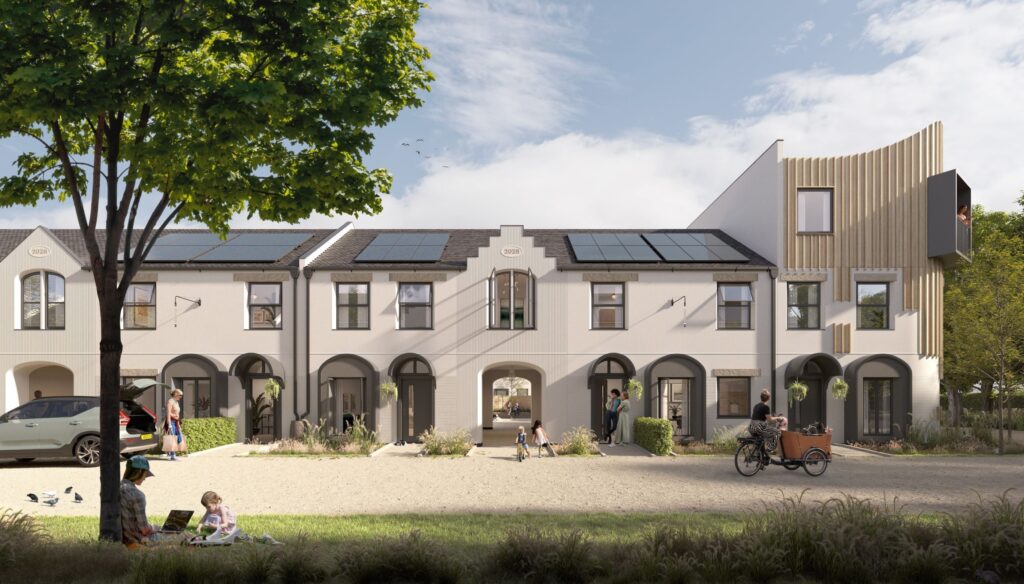
Practices, including ritchie*studio, Tate + Co, and MWD Architects, explain how the majority of their projects promote equity in society, and consider all people, not only the building inhabitants.
Creating a just space for people
Responses were assessed by Architecture Declare’s Alasdair Ben Dixon, Mandy Franz, Mark Goldthorpe, Tom Greenall and Mitakshi Sirsi, with input from Regenerative Architecture Index ambassador Immy Kaur – social and civil activist, and co-founder and director of CIVIC SQUARE.
Projects Question 3
Do the majority of your projects promote equity in society, and consider all people, not only the building inhabitants? For example, do your projects show due regard for workers within the supply chain and take active steps to avoid modern slavery?
Front-runner
ritchie*studio
We only work on projects with due consideration for all people, including contractors and their workers. We have rejected and resigned from projects where clients have disagreed with our design values, and do not work in regions of conflict or where governments’ abuse environmental and human rights. We recognise that modern slavery does occur within the construction industry, predominantly in the construction labour sector and in the production, manufacturing, and material resourcing sectors. We help to combat this by providing our staff with the knowledge to spot signs of modern slavery on construction sites; to understand specific sector and country risks in relation to project specification; to undertake due diligence in relation to all material and product specifications, including manufactured products no matter their origin; and to advise our clients of the risks within the sector which can increase with ‘cut-price’ cost competitiveness.
Runner-up
Tate + Co
All of our projects are designed to have the widest positive impact possible, beyond simply serving the needs of the buildings’ inhabitants. This includes providing as many broad social and community benefits as possible, such as creating jobs in the local supply chain, improving local economic opportunities, providing meaningful and publicly accessible community spaces, and creating improved sustainable transport links through our sites and developments.
In terms of the conditions of workers on our construction sites, we always operate as the CDM and BSA Principal Designers for our projects and are deeply involved in ensuring that contractors create safe and equitable working environments. This also includes completing background checks on all potential contractors and subcontractors, where we check their record and commitment to avoiding modern slavery.
Ones to watch
Cullinan Studio
Ethical practice is at the heart of how we work as a cooperative and we endeavour for this to translate across to our projects. One level is designing and detailing buildings in a humane way that expresses construction. This means for those assembling the building there are often smaller structural member sizes, or expressed guttering and rainwater goods making for easier maintenance and replacement. Using the transformative Integrated Project Insurance (IPI) model means that contractors, subcontractors, consultants and clients work together in a no-blame culture and design with safety of assembly and construction from early design stages. This was well demonstrated on the Black Country & Marches Institute of Technology, where the IPI approach had a revolutionary impact on the project team’s mental health, as they were no longer trying to pass the risk down the supply chain but instead could work collaboratively towards the most cost-effective solution.
Marks Barfield Architects
Our design process places the wider community at its heart, engaging local people to ensure our buildings address demographic, social, and cultural needs. We carefully specify responsibly-sourced materials with appropriate certifications, prioritising local suppliers to support regional economies, and reduce emissions. We also consider the ethical implications of sourcing, such as visiting stone quarries in Delhi to ensure safe working conditions and no child labour. Politically, we have taken a stand, divesting from Russian plywood in response to the war in Ukraine. Beyond the built outcome, we believe our time can offer the greatest social value. At Leyton Cricket Pavilion, for example, we pledged to run eight workshops across four local schools, mentor three young people throughout the construction process, and hold three additional workshops to involve local youth directly in the design – demonstrating our commitment to equity, education, and community contribution.
MWD Architects
We believe architecture should serve broader societal equity, not just immediate end users. Our projects are often designed with affordability and community benefit in mind, including social housing and One Planet Development schemes that promote access to low-impact living for a wider demographic. Through our sister company, MWD Makers, we maintain closer control over procurement and supply chains, prioritising local and ethical sourcing wherever possible. While we are a small practice and not currently subject to formal reporting obligations under the Modern Slavery Act, we are mindful of the origins and impacts of materials and labour, and favour transparent traceable suppliers, especially when working with timber and insulation products. Beyond compliance, we design with inclusivity in mind, ensuring our spaces are welcoming and accessible. We also promote community-centred development that supports resilience, wellbeing and equal opportunity across all aspects of our work.
Perkins & Will
We updated our processes in 2024 to reflect that integrity begins in the lives of the people who make projects possible. That’s why we’ve embedded a rigorous vetting process to champion human rights, fairness, and transparency. Modern slavery policies are non-negotiable in our work. We keep our supply chains as short as possible, not only to reduce environmental impact but to ensure we can stand behind the wellbeing of every worker involved. Our designers frequently visit factories – not just to understand the products, but to witness working conditions first hand. In previous projects alongside contractors, we’ve introduced a transparent scoring system for tier two suppliers, evaluating diversity of ownership, company size, and workforce representation. Every supplier is asked to provide clear policy documentation through our tailored questionnaire. This isn’t a box-ticking exercise – it’s a reflection of the world we want to help build.
Purcell
We do not have legal obligations under the Modern Slavery Act 2015. However, we are committed to ensuring our business practices are of exemplary standards both practically and ethically, and we have embedded and long-standing Corporate Social Responsibility (CSR) principles. Purcell voluntarily operates this policy and a Modern Slavery and Human Trafficking Statement, outlines our commitment to preventing slavery, human trafficking and forced and child labour in any part of our business and supply chain. As signatories to the RIBA Inclusion Charter, we are part of a new community of equity champions and role models committed to driving change through equality and new opportunities. RIBA has, in the past, accredited the Purcell Conservation School, a residential programme founded in 2016 and focused on transferring the knowledge of traditional conservation techniques that are crucial to the heritage-driven services we specialise in.
Studio Knight Stokoe
Our projects prioritise equity beyond building inhabitants, considering all people involved throughout the supply chain. As a Certified B Corporation, we have implemented a comprehensive Modern Slavery and Human Trafficking Policy demonstrating our commitment to treating society and the environment as vital stakeholders. We actively advocate for workers’ rights through our company documents and specifications, taking proactive measures to ensure fair labour practices and eliminate modern slavery risks. Our approach includes evaluating each project against the 17 UN Sustainable Development Goals, and conducting wide-ranging stakeholder engagement that considers impacts on neighbouring and wider communities. We maintain an environmental stewardship database featuring preferred suppliers and vendors who demonstrate ethical and environmental practices, including fair treatment of workers and active avoidance of modern slavery. This holistic approach ensures our projects create positive impacts beyond their immediate scope, fostering a more equitable and ethical business ecosystem.
We Made That
80 per cent of our projects benefited served communities in 2024. We take a structured approach to our mission, ethics, accountability, and transparency to ensure equitable impact. This means engaging our team, clients, and the community in achieving that mission, as well as dedicating time and resources to achieving it. Our impact is evaluated through approaches to equitable governance, balancing the influence of different stakeholders, and holding leadership accountable for social and environmental commitments. Best practices include establishing a foundation for ethical decision-making, transparency, fostering trust, and reinforcing collective commitment to positive societal impacts. As part of our contract start-up processes as a B Corp, appointed subconsultants provide details on ownership diversity, and social and environmental impact. This includes compliance, such as avoiding modern slavery or exploitation, and enables us to take evidence-led decisions on our supply chain makeup, as well as identify areas for proactive attention.